







Introducing EPSS Pulse: monitoring volatility in vulnerability risk

|
Updated

Greetings from Las Vegas! Today, I had the privilege and pleasure to grace the Black Hat stage and talk all about vulnerability scoring systems like CVSS, EPSS, SSVC, and other systems for determining software vulnerability “threatiness.”

While there is a lot to dissect within the whole talk and paper, I wanted to take a minute to zoom into one of the findings about scoring systems that I think is super interesting — so interesting, in fact, that we’re launching a fun little widget today so you can play along at home: EPSS Pulse.

During the course of my research, I noticed something interesting about EPSS: while there are loads of high-scoring vulnerabilities, what may be more interesting and relevant are those CVE-identified vulnerabilities that have seen recent, dramatic shifts in their EPSS scores.

Take for example, CVE-2015-3306 for ProFTP. It’s a ten year old vulnerability that’s been hovering around a 94% score since I started looking. That’s a pretty high score…critical even! But, it’s stable, and almost certainly already remediated by everyone who cares about the security of their ProFTP install. So, in the end, kind of boring.

Compare this to CVE-2025-54309 for CrushFTP. Pretty recent, and when it was published, it had an extremely low EPSS score of less than 0.1%. Totally ignorable! But then, on July 23, it leapt up to 74.4%. That seems like something worth paying attention to, and a reason to kick off a quick OSINT investigation to see if we can find out why this vulnerability is suddenly hot.

So, wouldn’t it be cool to be able to quickly and easily check to see what today’s EPSS fast movers are? While I wrote some shell scripting to do just that, the team here at runZero put together EPSS Pulse, the whiz-bang web app that does all the comparison work automatically, without a bunch of typing and grepping. Oh, and it’s quite pretty:
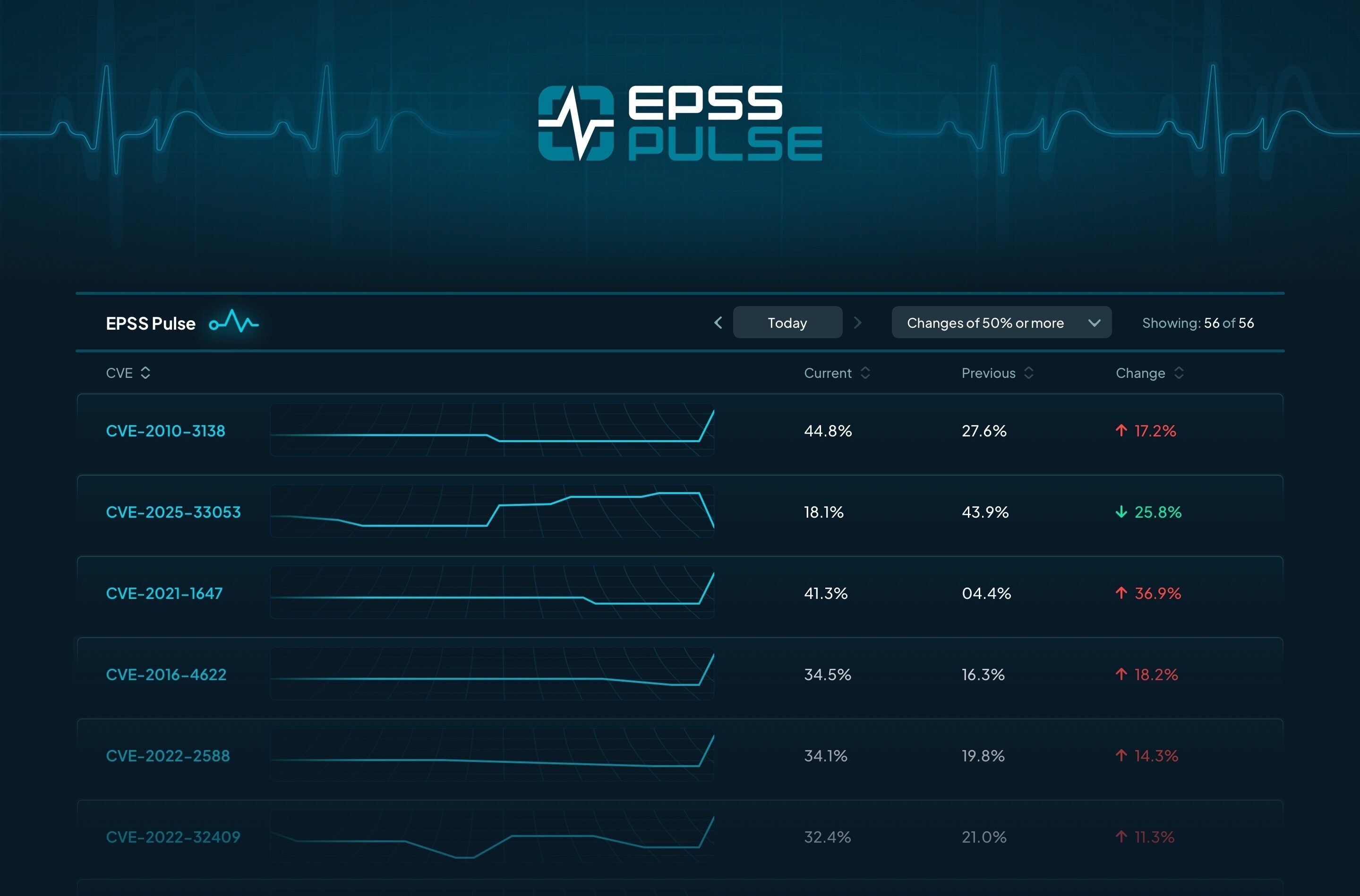
EPSS Pulse

The part I really like about this tool is that you can see, at a glance, not only the recent big-movers, but also a snapshot of their recent history. Does today’s hot vuln have a habit of bouncing between two dramatically different scores, or did it creep up for a little while, or did it just jump yesterday after languishing in obscurity? This is a great bit of context that can quickly sketch out the shape of a suddenly-interesting vulnerability and decide if it’s worth following up.

All that said, I do worry that this is just another exercise in omen-checking. After all, EPSS pulls in signal data from all sorts of sources, and some of those sources are proprietary and opaque, so the “why” of a recent jump can still be a little mysterious. Scrying these reasons are still on you, the intrepid OSINT investigator, to figure out. But, EPSS Pulse can give you a handy starting place in measuring these score changes, so this seems like a pretty decent tool to help you figure out which vulnerabilities to chase today. Give it a whirl for a few days, and let me know what you think!


Written by todb

Tod Beardsley is VP of Security Research at runZero, where he "kicks assets and fakes frames." Prior to 2025, he was the Section Chief for the Vulnerability Response section for CSD/VM/VRC at CISA, the Cybersecurity and Infrastructure Security Agency, part of the US government, and a seasonal Travis County Election Judge in Texas. He's also a founder and CNA point of contact for AHA!. Tod spends much of his time involved in vulnerability research and coordinated vulnerability disclosure (CVD). He has over 30 years of hands-on security experience, stretching from in-band telephony switching to modern ICS/OT implementations. He has held IT ops, security, software engineering, and management positions in large organizations such as the US Government, Rapid7, 3Com, Dell, and Westinghouse, as both an offensive and defensive practitioner. Tod is a CVE Board member, has authored several research papers, and is an internationally-tolerated horror fiction expert.

More about todb
Subscribe Now

Get the latest news and expert insights delivered in your inbox.

Welcome to the club! Your subscription to our newsletter is successful.

Explore more runZero

Product
runZero 5.1 is here: Secure AI workflows, enhanced integrations, and expanded autonomous discovery
runZero 5.1 takes on the heavy lifting across five key areas, enabling you to unmask and remediate exposures with less friction and more speed.
Podcasts
Know Your Adversary with HD Moore
runZero CEO HD Moore breaks down the myth of air-gapped networks, the impact of AI on security, and why asset connectivity is everything.
runZero Perspective
BOD 26-04: A new era of prioritized remediation
A complete breakdown of CISA's BOD 26-04 directive. Learn how the shift to SSVC, risk-based KEV prioritization, and 3-day remediation impacts your...
runZero Perspective
Dawn of the apex agentic adversary
When agentic AI can weaponize exploits in seconds, visibility is everything. Stop the predator with runZero’s exposure management for the AI-attack...
Webcasts
runZero Hour, Ep. 33: Hacker Summer Camp: we survived the Vegas heat (and the bugs)
In this post-Hacker Summer Camp recap, the runZero team break down the research, tools, and trends discussed at BSides Las Vegas, Black Hat and DEF...
Podcasts
The Internet's biggest point of failure
Join Tod Beardsley on Secure & Scale as he explores the future of vulnerability management, CVE fragmentation, and how AI is changing security...
Webcasts
Mind the gaps: securing the modern IT/OT attack surface
In this webcast, HD Moore and GigaOm Analyst Chris Ray discuss key methods for hardening OT defenses and share insights from the new OT report.
Webcasts
runZero Hour, Ep. 32: AI-pocalypse now? Why the 2026 DBIR is actually good news
In this episode of runZero Hour, Tod Beardsley, Brianna Cluck, and Verizon's Alex Pinto broke down 2026 DBIR trends, AI threats, and runZero 5.0.

See Results in Minutes

See & secure your total attack surface. Even the unknowns & unmanageable.