https://www.runzero.com/blog/Blog2025-04-29T12:00:00-04:00https://www.runzero.com/blog/apple-airplay/How to find Apple AirPlay devices on your network2025-04-29T12:00:00-04:002025-04-29T12:00:00-04:00Several AirPlay vulnerabilities were resolved in Apple's latest OS updates. Here's how to find potentially vulnerable devices on your network.runZero Team
Latest Apple AirPlay vulnerabilities
Several vulnerabilities, collectively known as AirBorne by Oligo Security researchers, were disclosed in the latest releases of its macOS, tvOS, iOS, and iPadOS operating systems.
CVE-2025-24252 and has been rated highly critical with a CVSS score of 9.8.
CVE-2025-24206 and has been rated critical with a CVSS score of 7.7.
When exploited independently or chained together, local attackers can perform several different attacks on vulnerable devices including remote code execution and sensitive information disclosure.
CVE-2025-24252 potentially allows a local attacker to remotely execute code. When chained together with CVE-2025-24206, a local attacker could potentially attack other devices connected to an Apple device through the AirPlay protocol.
CVE-2025-24132 allows a local attacker the potential ability to remotely execute code on third-party devices using Apple's AirPlay SDK. For devices with a microphone, successful exploitation could lead to information disclosure through eavesdropping.
Are updates available?
The Apple-specific device issues have been resolved in the following operating system updates:
macOS Ventura 13.7.5, Sonoma 14.7.5, Sequoia 15.4
iOS 18.4
iPadOS 17.7.6, 18.4
tvOS 18.4
visionOS 2.4
CVE-2025-24132 was resolved in Apple's AirPlay audio SDK 2.7.1, Airplay video SDK 3.6.0.126, and CarPlay Communication Plug-in R18.1 updates.
How do I find potentially vulnerable Apple devices with runZero?
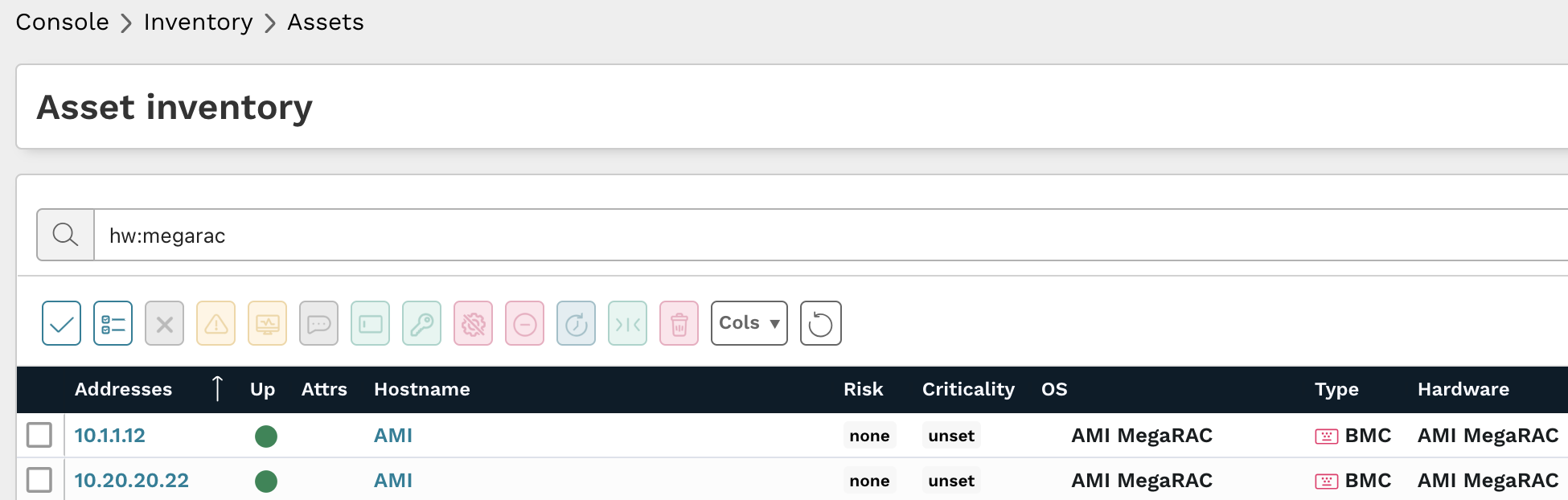
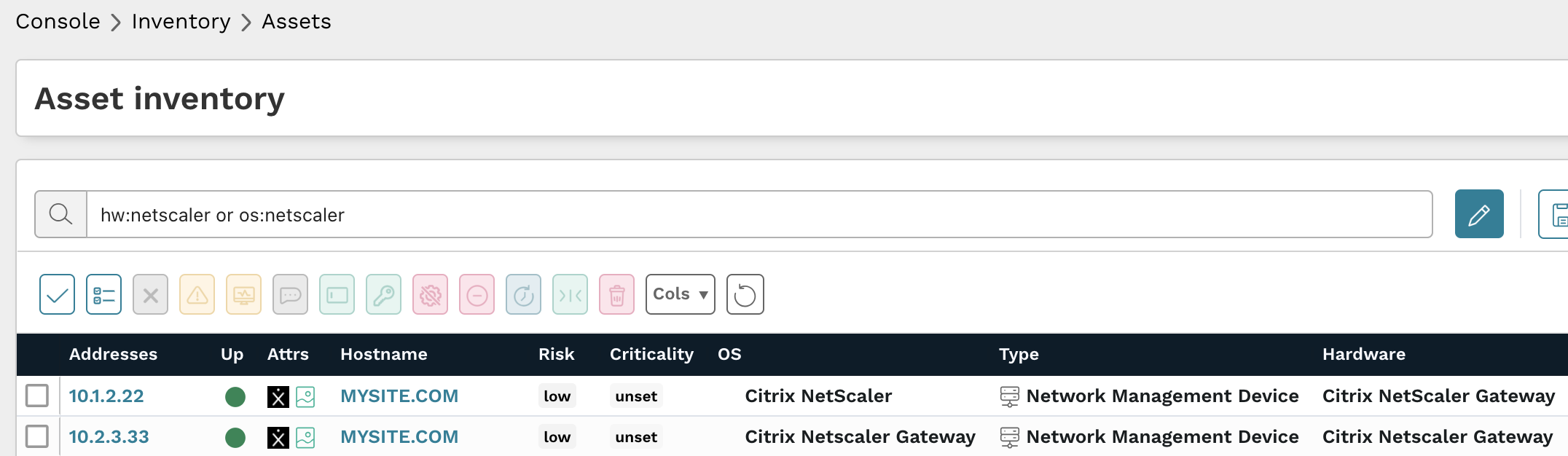
Vulnerable devices can be found by navigating to the Asset Inventory and using the following query:
hw:Apple AND protocol:airplay
How do I find potentially vulnerable third-party devices with runZero?
Vulnerable devices can be found by navigating to the Services Inventory and using the following query:
_asset.protocol:airplay AND protocol:airplay AND not hw:Apple
]]>
https://www.runzero.com/blog/prioritizing-stack-not-cves/One Asset, Many Risks: Prioritizing the Stack Instead of the CVEs2025-04-29T11:00:00-04:002025-04-29T11:00:00-04:00runZero surfaces stacked, asset-level risks—like misconfigurations, EOL software, and weak segmentation—that traditional vulnerability scanners overlook when prioritizing by CVE score alone.Wes Hutcherson
Attackers don’t care about CVSS scores — they care about what gets them access. Most of the time, that means taking the path of least resistance: exposed services, misconfigurations, weak segmentation, and other soft spots that rarely show up in traditional vulnerability scans.
And yet, most vulnerability management programs still focus on the obvious: high-severity CVEs with big scores and flashy names. But that approach misses broad classes of exposures. Some of the riskiest assets in your environment don’t have a single critical vulnerability. Instead, it’s the combination of moderate CVEs and non-CVE risks— stacked together — that opens the door to compromise.
To stay ahead, you need a solution that evaluates risk like an attacker does: by looking at the whole picture, not just the highest score.
Why CVSS On Its Own Doesn’t Cut It
Risk isn’t just about numbers — it’s about the context behind those numbers. Let’s say you scan your environment and find a CVE with a 5.6 score — a medium risk. A quick triage might toss it into the “not urgent” pile in favor of higher-scoring threats. But what if that vulnerability is found on an asset that:
Is running End-of-Life (EOL) software, meaning no patches are coming
Is exposed to the internet, making it easy prey
Has another vulnerability listed in CISA’s KEV catalog
Is multi-homed, bridging internal network segments
Lacks security controls, like EDR, or has misconfigured permissions
Is unmonitored or unmanaged, falling outside standard patch or detection routines
Suddenly, your “medium” CVSS vulnerability just became a high-priority issue.
Did the CVSS score somehow change? No, just the context.
And this scenario plays out all the time. Traditional scanners are notorious for burying real-world risks beneath mountains of “critical” CVEs — giving attackers plenty of room to slip through the cracks.
At runZero, we want to help you manage exposure, not just chase scores.
runZero: The Context Engine
By prioritizing based on stacked risks at the asset level, the endless queue of high-priority items shrinks. Focusing on stacked risks means shorter remediation lists, faster progress, and fewer fires — without burning out the security team.
That’s where runZero comes in. runZero doesn’t just identify exposures and blindly rank them. We build deep context around every asset. Here’s how.
First, we discover everything across your environment: IT, OT, IoT, cloud, mobile — even the unmanageable and unknown — across both your internal and externalattack surfaces.
Then, we go deeper. Our advanced fingerprinting uncovers critical insights into services, connections, ownership, hygiene, and more, building detailed profiles of each asset leveraging a library of almost 1000 attributes.
Our exposure discovery goes beyond CVEs, surfacing a broader range of threats that traditional scanners miss, including:
Misconfigurations
Missing security controls
Weak segmentation
Internally hosted assets that are accidentally public
Insecure or unnecessary services
Risky assets bridged to other networks and devices
These weak spots don’t always show up on a vulnerability scan but still offer easy footholds to attackers. Our deep asset-level data and coverage of non-CVE exposures is the critical context that allows runZero to correlate multiple risk signals into meaningful, actionable exposures enabling you to tackle the highest risks first.
Let’s take a closer look at a real example in the runZero Platform to see how we surface stacked risk that CVSS alone misrepresented.
Complete Context Delivers Better Outcomes
Prioritization of individual CVEs is the same as judging a storm by just one cloud. Sure, it might be dark, but that certainly isn’t the whole forecast.
With runZero, you see the full storm front, providing asset-level context that indicates where risk factors converge. More importantly, you know exactly what to tackle first. No more guesswork. No more noise. Just clear signals, actionable exposure management, delivered.
Want to uncover your riskiest assets? Start a free runZero trial and start stacking the odds in your favor.
]]>
https://www.runzero.com/blog/craft-cms/How to find Craft CMS on your network2025-02-21T11:55:00-05:002025-04-28T12:00:00-04:00Two zero-day vulnerabilities impacting Craft CMS are being actively exploited. Here's how to find Craft CMS on your networks with runZero.runZero Team
Latest Craft CMS vulnerabilities
Two zero-day vulnerabilities impacting Craft CMS are being actively exploited by chaining the vulnerabilities together to compromise the affected systems.
CVE-2025-32432 is rated critical with a CVSSv3 base score of 10.0.
CVE-2024-58136 is rated critical with a CVSSv3 base score of 9.0. This vulnerability is found within the Yii framework, which is used by Craft CMS.
What is the impact?
Successful exploitation of the vulnerabilities when chained together potentially allows a remote attacker the ability to breach vulnerable systems and transfer potentially sensitive data after installing a PHP-based file manager on compromised systems.
Are updates available?
Although the Yii framework update is not included in the latest Craft CMS patch, the primary vulnerability was patched within 3.9.15, 4.14.15, and 5.6.17. Users are strongly encouraged to update their installation as soon as possible. In addition to applying a patch, users might want to rotate their security keys as a safety precaution. Additionally, a best practices write-up is available online with steps on how to harden the security of the installation.
How do I find potentially vulnerable instances with runZero?
From the Service Inventory, use the following query to locate systems running potentially vulnerable software:
_asset.protocol:http AND protocol:http AND (has:http.head.xPoweredBy AND http.head.xPoweredBy:="Craft CMS")
February 2025: CVE-2025-23209
In late January, CraftCMS published a security advisory for a code injection vulnerability that can lead to remote code execution. On February 20, 2025 CISA added CVE-2025-23209 to the known exploited vulnerabilities catalog (KEV).
What is the impact?
Successful exploitation of the vulnerability requires that a remote attacker already has control of the installation's security key. In this case, the attacker can then inject code using an specially crafted backup directory variable provided by the user.
The affected versions include:
Versions greater than or equal to 5.0.0-RC1 through 5.5.5 (exclusive)
Versions greater than or equal to 4.0.0-RC1 through 4.13.8 (exclusive)
Are updates available?
The vulnerability was patched in 5.5.8 and 4.13.8. Users are strongly encouraged to update their installation as soon as possible. In addition to applying a patch, users might want to rotate their security keys as a safety precaution. Additionally, a best practices write-up is available online with steps on how to harden the security of the installation.
How do I find potentially vulnerable instances with runZero?
From the Service Inventory, use the following query to locate systems running potentially vulnerable software:
_asset.protocol:http AND protocol:http AND (has:http.head.xPoweredBy AND http.head.xPoweredBy:="Craft CMS")
]]>
https://www.runzero.com/blog/commvault-command-center/How to find Commvault servers on your network2025-04-28T11:10:00-04:002025-04-28T11:10:00-04:00Commvault published a security advisory for a critical security vulnerability identified in the Command Center installation. Here's how to find potentially vulnerable services on your network.runZero Team
Latest Commvault vulnerability: CVE-2025-34028
Commvault published a security advisory for a critical security vulnerability found in the Command Center installation.
This vulnerability has been assigned CVE-2025-34028 and has been rated highly critical with a CVSS score of 10.0.
What is the impact?
This vulnerability is only found within the 11.38 Innovation Release (11.38.0 through 11.38.19). A path traversal vulnerability identified in the Command Center installation allows an unauthenticated attacker to upload ZIP files, which could lead to remote code execution.
Are updates available?
Commvault has issued a 11.38.20 release that patches the vulnerability.
How do I find potentially vulnerable software with runZero?
Vulnerable services can be found by navigating to the Services Inventory and using the following query:
_service.last.http.uri:="%commandcenter%" AND _service.protocol:http AND _asset.protocol:http
]]>
https://www.runzero.com/blog/four-days-until-rsac-25/Only Four Shopping Days Left Until RSAC!2025-04-24T13:56:00-04:002025-04-24T13:56:00-04:00In which Tod assures his fellow nerds that RSA Conference isn’t just for marketing hypesters.todb
I’m about to curl up with my copies of the GreyNoise report on resurgent vulnerabilities and the Verizon DBIR, since both reports promise thrills and chills, but I wanted to drop a note here to talk just a little bit about RSAC next week.
If you’ve ever read this blog before, you probably know that RSAC is the other annual pilgrimage that a lot of infosec/cybersecurity professionals take, and it starts next week. RSAC is the Easter to Black Hat’s Christmas — important for adherents, completely wrecks many calendars, fun for kids, all that. I also know that a lot of self-identified “tech people” can get kind of eye-rolly about RSAC, and are quick to dismiss it as an event purely for “biz people” like marketing, C-suite, and venture capital types.
I’m here to tell you that I actually like RSAC, and I participate in it quite willingly, even eagerly. Here’s why: While there is undoubtedly a bunch of silliness and hype and puff surrounding RSAC, I take it as an opportunity to walk up to a vendor and get into a conversation with a sales or product engineer about how they’re doing whatever magic they’re claiming to do. Sometimes, I run into a marketing gatekeeper, but they’re usually pretty well-trained to deflect harder technical questions to the SE pretty quickly.
A couple weeks ago, we chatted with Tracy “InfosecSherpa” Maleeff on Storm⚡️Watch, and she professed pretty much the same strategy — be sincere, ask questions, and seek out the technical expert on site. I have to say, it was so nice to hear that I’m not the only one who sees this value in RSAC. I learned, pretty early on, that this show isn’t just a marketing opportunity for the vendors, it’s a learning opportunity for you. If you understand that the marketing messages are probably a little hyperbolic, forgive them for that, move past it, then see what’s up in whatever area of cybersecurity that you’re not already an expert in. You’ll stand a pretty good chance of being slightly better-rounded in your career and your interests after that conversation, and maybe even get some ideas on how to blend what you’re doing with whatever they’re doing.
So, go forth, enjoy RSAC, collect some swag for the kids, and learn a thing or two. It’ll be fun.
All that said, it would be a marketing crime if I didn’t remind you of the events that runZero has planned for next week across both BSidesSF and RSAC. I’ll focus specifically on those most geared for nerds:
Charting the SSH Multiverse: HD revisits the vast attack surface of SSH, covering vulnerabilities and exposures that come with this venerable protocol. Spooky!
Discovering OT Devices Across Protocol Gateways: Rob pokes and prods at operational technology (OT), and yet, does not crash the factory floor by doing so. Amazing!
RSA Hottest Innovators Party: Hosted by Ghost and runZero, a great opportunity to ask some of those harder technical questions to the founders of some of the neatest infosec startups around.
Hit our San Francisco landing page for registration links to these and the other events we’ll be at, and I’ll probably bug you about some network stack trivia next week!
]]>
https://www.runzero.com/blog/ditch-vulnerability-scanners/Ditch Vulnerability Scanners: A Smarter Approach to Exposure Management with runZero Alongside Endpoint Agents2025-04-22T15:20:00-04:002025-04-22T15:20:00-04:00Ditch your vulnerability scanners. Leverage your endpoint agents for authenticated discovery. Use runZero for everything else. It's exposure management reimagined.Wes HutchersonA few weeks ago, we launched powerful new capabilities in runZero that mark a new era in exposure management. As part of that release, we took direct aim at overcoming long-standing challenges with vulnerability scanners.
Traditional vulnerability management platforms were designed for a world that no longer exists — and they stopped innovating a long time ago. They were introduced back when networks were static, assets stayed on-prem, and scans could reach everything. But today’s environments are anything but predictable and controllable.
Hybrid infrastructure, distributed workforces, edge devices, and IT/OT convergence have completely reshaped the attack surface. Vulnerability scanners haven’t kept up, producing overwhelming volumes of alerts while completely missing critical exposures that are highly exploitable.
So, what’s the move?
Ditch your vulnerability scanners. Leverage your endpoint agents for authenticated discovery. Use runZero for everything else.
This modern approach gives you better coverage, deeper visibility, and less operational overhead. It’s exposure management reimagined for today’s dynamic environments.
Legacy Scanners Are Falling Short
Legacy vulnerability scanners were built for a different time — when networks had clear perimeters, assets were reachable, and credential-based scanning was feasible across the board.
That world doesn’t exist anymore.
Today, your environment is:
Hybrid and constantly changing
Remote-first, with endpoints scattered across the globe
Full of unmanaged, unknown, and unscannable assets
Populated with fringe devices at the network edge
The latter are precisely the types of assets most likely to be missed by agents and excluded from scheduled scans — yet they often present the highest risk.
Legacy scanners also tend to be disruptive to sensitive systems and prone to crashing things you don’t want to knock over. This renders them useless in OT environments and for things like IoT and unmanaged devices, yet these assets are frequently targeted by attackers. Plus, these tools are typically slow, delivering results well after windows of exploitability have opened.
So what now? Stick with what’s familiar and hope nothing slips through the cracks? Of course not. But ripping out your existing scanner and starting from scratch isn’t always realistic either — especially when your workflows and metrics are tied to vulnerability counts.
You Already Have Authenticated Vulnerability Data
Here’s the irony: you already have a better source of authenticated vulnerability data. You may just not be using it.
If you’ve deployed endpoint detection and response (EDR) agents, then you may already have real-time, authenticated vulnerability data at your fingertips.
There’s no need for complex credential vaults, no limited scan windows, no waiting for point-in-time scan results. You’ve already got what you need. Why not use it?
But here’s the challenge — these tools give you vulnerability data without the network context. They tell you what’s wrong, but not whether those vulnerabilities are exposed or reachable by an attacker. That’s where runZero comes in to connect the dots, plus identify additional exposures that agent-based approaches still miss.
runZero Covers Everything Else
Endpoint agents are powerful, but they can’t see everything.
runZero’s exposure management platform is purpose-built to find assets and risks traditional tools and endpoint agents can’t. We discover and fingerprint every device across your total attack surface including IT, OT, IoT, cloud, and mobile devices. We even find unmanageable, rogue, or entirely unknown assets that agents can’t touch.
Additionally, we highlight risks that other tools may report, but not at the appropriate severity level. For example, many vulnerability scanners detect unauthenticated “ZooKeeper” services, but report this as an information-vulnerability, not an exposure that can leak application secrets to an unauthenticated attacker.
Want to find protocols running on unusual ports, exposed remote access services, open databases with default credentials, segmentation violations, or devices improperly bridged across internal and external networks? runZero sees them.
We’re also leading the way in uncovering exploitable paths that never show up in external scans but pose massive internal risk. Learn more about our inside-out attack surface management capabilities.
runZero + Endpoint Agents: A Smarter, Integrated Approach
Modern exposure management doesn’t need more tools — it needs a more effective approach.
runZero’s deep integrations with leading endpoint detection and response vendors enable you to:
Enrich asset records with agent details, OS info, and operational state
Ingest full software inventories
Pull in authenticated vulnerability data direct from the agent
This data merges seamlessly with runZero’s unauthenticated discovery and fingerprinting to give you a complete, contextualized view of every asset in your attack surface and its exposures including which ones are reachable, misconfigured, or otherwise primed for compromise.
See Endpoint Agent Vulnerability Data + runZero in Action
Curious to see how it all comes together? Let’s take a closer look at what this looks like inside the runZero UI.
Next Steps
It’s time to move away from legacy vulnerability management. There’s a smarter path forward — one that pairs the endpoint agents you already have with what you've been missing: runZero.
]]>
https://www.runzero.com/blog/asus-aicloud-routers/How to find ASUS AiCloud routers on your network2025-04-21T16:54:00-04:002025-04-21T16:54:00-04:00ASUS has disclosed a 'highly critical' vulnerability in several of its router models using its "AiCloud" functionality. Here's how to find impacted assets with runZero.Rob King
Latest ASUS AiCloud router vulnerability: CVE-2025-2492
ASUS has disclosed a vulnerability in several of its router models using its "AiCloud" functionality. Designated as CVE-2025-2492, this vulnerability allows an attacker to bypass authentication mechanisms on the router. Successfully exploiting this vulnerability would allow an attacker to alter the configuration of the router and potentially execute arbitrary code. This vulnerability is considered highly critical with a CVSS score of 9.2.
What is the impact?
Successful exploitation of these vulnerabilities would allow an attacker to take control of the vulnerable devices. As these devices are generally located at the network edge, they are often exposed to the public internet.
Are updates or workarounds available?
ASUS has released updated firmware for the affected devices. Users are urged to update as quickly as possible. Users are also encouraged to to disable the "AiCloud" feature of their routers until the latest firmware patch has been applied.
How do I find potentially vulnerable systems with runZero?
From the Assets Inventory, use the following query to locate systems running potentially vulnerable systems:
os:="Asus AsusWRT 382" OR os:="Asus AsusWRT 386" OR os:="Asus AsusWRT 388" OR os:="Asus AsusWRT 102"
]]>
https://www.runzero.com/blog/erlang-otp-ssh/How to find Erlang/OTP SSH servers on your network2025-04-17T12:01:00-04:002025-04-17T12:01:00-04:00Some versions of the Erlang/OTP embedded SSH server contain a highly critical vulnerability (CVE-2025-32433) in their handling of SSH protocol messages. Here's how to find impacted versions on your network.Rob King
Latest Erlang/OTP SSH vulnerability: CVE-2025-32433
Certain versions of the Erlang/OTP (Open Telecom Platform) embedded SSH server contain a vulnerability in their handling of SSH protocol messages. Successfully exploiting this vulnerability would allow an attacker to execute arbitrary code with the privileges of the Erlang process.
This vulnerability has been assigned CVE-2025-32433 and has been rated highly critical with a CVSS score of 10.0.
Cisco has announced that multiple Cisco products contain a vulnerable version of the Erlang/OTP SSH server, and these products expose the vulnerable service:
Cisco ConfD and ConfD Basic (Cisco bug ID CSCwo83759)
Cisco Network Services Orchestrator (NSO) (Cisco bug ID CSCwo83796)
Patches for these products have not yet been released, and it appears that there are at least 3,000 exposed and likely vulnerable systems on the Internet.
Are updates available?
The Erlang project has released updates that address these vulnerabilities.
Note that the embedded SSH component can be updated independently of the overall OTP platform, and thus the version numbers for the embedded SSH component are tracked separately from the overall library.
Also, please note that while the Erlang project has released updates, vendors who embed the vulnerable service will need to provide updates individually for their products.
How do I find potentially vulnerable versions of the Erlang/OTP SSH server with runZero?
Vulnerable services can be found by navigating to the Software Inventory and using the following query:
_asset.protocols:ssh AND vendor:="Erlang" AND product:="SSH" AND ((version:>=5.2.0 AND version:<5.2.10) OR (version:>4.0.0.0 AND version:<4.15.3.12) OR (version:>5.1.0.0 AND version:<5.1.4.7))
Vulnerable Cisco ConfD installations can be found by navigating to the Services Inventory and using the following query:
_asset.protocols:ssh AND protocol:ssh AND banner:="SSH-2.0-ConfD"
]]>
https://www.runzero.com/blog/cve-marches-on/CVE Marches On2025-04-16T18:26:00-04:002025-04-16T18:26:00-04:00On April 15, 2025, the CVE program faced sudden shutdown fears — but CISA stepped in with last-minute funding. Crisis averted, for now.todb
Good news, everyone!
I just dropped off the regularly scheduled CVE Board meeting (which I often go to, seeing as how I’m on the
CVE Board), and wanted to share a quick update with all my infosec friends on the state of the CVE program, from my own point of view as a CVE Board member (and not speaking on behalf of the CVE Board). TL;DR: CVE continues to CVE, without an interruption in funding.
To recap:
Yesterday, on April 15, 2025 (does US Tax Day make this ironic?), Yosry Barsoum of the MITRE Corporation
informed the CVE Board
that there was a potential risk to the continued operation of the CVE program, with scary phrases like “will expire” and “break in service.”
This communication to the CVE Board leaked almost immediately — I didn’t see it in my email until I heard about it in about a dozen Signal chats I’m in.
Cue a day of widespread hand-wringing for most vulnerability intelligence professionals and hobbyists. But today, April 16, 2025,
news attributed to CISA
indicated they had found a solution late last night. From what I understand, CISA “executed the option period” on the contracting with MITRE, which means that CISA will continue to fund MITRE for CVE services for the next eleven months, give or take.
At the CVE Board meeting, we spent most of the time there with representatives from CISA (the funding organization of CVE) and MITRE (the operators of CVE). I won’t get into the weeds, but I will say that both organizations reassured the CVE Board multiple times and in as much clarity as humanly possible, that the CVE program will continue unabated.
Of course, while CVEs do not encompass the full scope of network security issues, I think we can all agree that they are still a critical component to track as part of a robust security program. Over the last 25 years, the CVE program has evolved into a critical, shared, and global resource that ultimately helps IT defenders keep their constituents safe and secure, and it’s important for this work to continue. (That said, if you want to dive into all of the other non-CVE exposures that we here at runZero think are equally important to detect and prioritize, we encourage you to watch our webcast with Omdia, now available on demand).
I look forward to continuing my side-gig as a CVE Board member and remain passionate about improving the CVE program to better serve the needs of the world's IT heroes — capes or no capes.
]]>
https://www.runzero.com/blog/lantronix/How to find Lantronix Xport devices on your network2025-04-15T12:35:00-04:002025-04-16T00:00:00-04:00On April 15, 2025, CISA published an advisory announcing that certain versions of the Lantronix Xport products are vulnerable to an authentication bypass vulnerability.runZero Team
Latest Lantronix vulnerabilities: Xport
On April 15, 2025, CISA published an advisory announcing that certain versions of the Lantronix Xport products are affected by an authentication bypass vulnerability.
This vulnerability has been designated CVE-2025-2567 and has been assigned a CVSS score of 9.8 (critical).
What is the impact?
Successfully exploiting this vulnerability could allow an attacker unauthorized access to the configuration interface, leading to potential disruption to monitoring and operations.
Xport versions 6.5.0.7 through 7.0.0.3 are vulnerable.
Are updates or workarounds available?
Lantronix recommends that users upgrade to their Xport Edge product, which is not affected by this vulnerability.
As a mitigation, the general recommendation is to limit network exposure for all control systems and devices. In general control systems and devices shouldn't be directly connected to the public internet. In most cases they're not designed with security in mind and depend on another edge device.
How do I find potentially vulnerable systems with runZero?
From the Asset Inventory, use the following query to locate potentially vulnerable systems:
hw:lantronix AND ((os:="Lantronix XPort%" AND not os:="Lantronix XPort Edge%") OR (lantronix.type:="XE" OR lantronix.type:="SE" OR lantronix.type:="AR" OR lantronix.type:="EH"))
]]>
https://www.runzero.com/blog/crushftp/How to find CrushFTP services2024-04-12T12:54:00-04:002025-04-14T17:00:00-04:00CrushFTP disclosed that a vulnerability in their file transfer product allows an unauthenticated remote attacker to bypass authentication on some HTTPS interfaces. Here's how to find potentially impacted assets.HD Moore
Latest CrushFTP vulnerability (CVE-2025-31161)
CrushFTP disclosed that a vulnerability in their file transfer product allows an unauthenticated remote attacker to bypass authentication on some HTTPS interfaces. Since the original disclosure, a CVE was assigned, CVE-2025-2825, and later, CVE-2025-31161. This vulnerability is being exploited in the wild.
What is the impact?
Successfully exploiting this vulnerability would allow an attacker to execute administrative functions within the CrushFTP service without authentication. Versions of CrushFTP 11 prior to 11.3.1 and CrushFTP 10 prior to 10.8.4 are vulnerable.
Are updates or workarounds available?
CrushFTP has released versions 11.3.1 and 10.8.4 to address this issue. The vendor has also indicated that enabling the DMZ setting in the CrushFTP configuration will mitigate this issue. CrushFTP administrators are advised to update at their earliest opportunity.
How do I find potentially vulnerable systems with runZero?
From the Software Inventory, use the following query to locate systems running potentially vulnerable software:
_asset.products:CrushFTP AND product:CrushFTP
Previous CrushFTP vulnerability (April 2024)
CrushFTP disclosed that a vulnerability in their file transfer product allows an unauthenticated attacker to access the host's file system. No CVE has yet to be assigned for this issue and CrowdStrike has indicated that this issue is being actively exploited in the wild. Additional details can be found in this article by Sergiu Gatlan at BleepingComputer.
What is the impact?
This issue affects all CrushFTP versions prior to 10.7.1 and CrushFTP 11 releases prior to patch 11.1.0. An unauthenticated attacker can abuse this issue to read files from the host's file system.
Are updates or workarounds available?
CrushFTP has released versions 10.7.1 and 11.1.0 to address this issue.
How do I find potentially vulnerable systems with runZero?
From the Asset Inventory, use the following query to locate systems running potentially vulnerable software:
product:crushftp
]]>
https://www.runzero.com/blog/vulncon-2025-wrapup/VulnCon 2025 Wrapup2025-04-14T11:46:00-04:002025-04-14T11:46:00-04:00Last week, I got to see friends, enjoy Carolina barbecue, and hang out with super smart, fun people. VulnCon has turned out to be one of the most easily justified conferences of my year.todb
Last week, I got the opportunity to hang out with a few hundred of my closest vulnerability-handling friends at VulnCon 2025, held in smoky, barbecue-infused Raleigh, North Carolina.
VulnCon is one of the most surprisingly worthwhile security conferences in the U.S., and it’s only in its second year. Organized by a joint effort of the CVE Program and FIRST, VulnCon attracts about 600 people from this weird little corner of cybersecurity: a niche of a niche of a sector of the industry. It’s all people who care about identifying, describing, cataloging, archiving, and predicting software vulnerabilities. Occasionally, we’re interested in actually fixing or preventing them. But the fact is, we’re still in a period of human history where information systems are going to have security bugs — and kind of a lot of them — so keeping them straight seems pretty important.
Hyperfocused Content
I love these goofy nerds. We’ve all somehow managed to find ourselves in this oftentimes uncomfortable space of figuring out how to communicate effectively about technical vulnerabilities to “stakeholders,” which range from IT ops professionals to government regulators. Which vulnerabilities are important enough to drop what you’re doing and address right now? And more importantly, how can you tell?
Of course, we deal with the kinds of activities and problem spaces seen at larger, more general conferences. Many who went to VulnCon last week will be at BSidesSF and RSAC next week. Even so, there’s something magical that happens when you spend a few days with folks zeroed in on this very specific problem space.
There were nearly a hundred distinct talk tracks, hyperfocused on vulnerability identification and management. Titles ranged from the generally accessible (“How to Think About Vulnerabilities and Artificial Intelligence”), to the hands-on technical (“Using Jupyter Notebooks to Explore Public CVE Data”), to the almost comically esoteric (“EU CRA TL;DR for PSIRTs: What Product Security Needs To Do To Be Compliant with the CRA”). Like I said, VulnCon caters to a very specific sub-sub-subset of cybersecurity weirdos.
As you might suspect, this kind of problem space gets many of us out of bed in the morning at runZero, where we know it’s not just the named, CVE-identified vulnerabilities that bedevil our customers’ networks. We tackle those even-harder-to-find-and-describe misconfigurations, exposures, and goof-em-ups that present opportunities for attacker hijinks.
These aren’t the kinds of issues that show up neatly labeled in a vulnerability feed. They’re the edge cases: insecure-by-default services, forgotten development environments, shadow assets that never got inventoried. Exposure management means shining a light on all of it. And while that’s what runZero is built for, events like VulnCon give us a peek into how other teams are tackling these murky problems. We bring those insights back with us and apply them to our customers’ environments — helping them stay ahead of the chaos.
The Return of Chat
We had a fun innovation for this year’s VulnCon: every one of those nearly hundred sessions had its own dedicated Discord chatroom, where people could not only drop their “more of a comment than a question” thoughts, but have actual conversations before and after the session, sometimes lasting multiple days. This chat functionality served a couple of purposes. It allowed the audience to stay focused on the speaker while also giving an outlet to other experts in the room who probably do actually know a thing or two the speaker didn’t cover.
The chat also made this in-person event much more accessible for those who couldn’t make the travel to Raleigh work. So, if you’re involved in organizing technical conferences, take note: your community might benefit from a parallel text chat.
Hallway Con
For me, the most valuable part of attending in-person technical conferences is all the stuff that happens in the in-between spaces. For example, I got to spend a couple of hours with Jay Jacobs, a co-chair of the EPSS SIG, which was insanely valuable to me. There are features and effects of the Exploit Prediction Scoring System that kind of mystified me, and what we discussed will absolutely inform my upcoming talk at NorthSec in Montréal on Vulnerability Haruspicy.
I also got a chance to staff the CVE Program booth (since I’m on the CVE Board) and had a few really good interactions with people who had questions and concerns about the CVE Program. It was enlightening.
Finally, since it’s jointly organized by FIRST — and FIRST is all about the PSIRTs (Product Security Incident Response Teams) — I met a couple of people who ended up handling some vulnerability reports I was involved with over the last year. That aspect of conferences and symposia is often overlooked and wildly valuable. For those who habitually report vulnerabilities to vendors and producers of software, and those who receive and triage those reports, the relationship can be… adversarial. Creating personal connections goes a long way toward establishing trust and respect between researchers and actual doers.
Next Con!
So while I got to see friends, consume Carolina barbecue (which, as a Texan, is an exotic departure from my usual fare), and hang out with super smart and fun people, VulnCon has turned out to be one of my most easily justified conferences of the year. It’s small — but not too small — with about 450 in-person participants and another 150 or so online. For comparison, RSAC next week is expected to draw about 45,000 participants, which is just massive.
And while I fully expect to have a good time at BSidesSF and RSAC, I’d be pleasantly surprised if I walked away with the kind of technical enrichment I get from, and can offer to, smaller venues like VulnCon. See you next year!
]]>
https://www.runzero.com/blog/gladinet-centrestack/How to find Gladinet CentreStack installations in your network2025-04-10T11:48:00-04:002025-04-10T11:48:00-04:00A vulnerability in Gladinet's CentreStack collaboration product could allow an attacker to execute arbitrary code on vulnerable systems. Here's how to find potentially vulnerable installs on your network.Rob King
Latest Gladinet CentreStack vulnerability: CVE-2025-30406
Gladinet has disclosed a vulnerability in their CentreStack collaboration product that could allow an attacker to execute arbitrary code on vulnerable systems. This is due to a hard-coded cryptographic key present in these systems.
This vulnerability has been assigned CVE-2025-30406 and has been given a CVSS score of 9.0 (critical).
What is the impact?
An attacker with knowledge of the hard-coded cryptographic key could craft a malicious serialized payload that would be implicitly trusted by the vulnerable system and executed with full privileges.
Versions of CentreStack prior to 16.4.10315.56368 are vulnerable. There is evidence that this vulnerability is being actively exploited in the wild.
Are updates or workarounds available?
Gladinet has released updates that address these vulnerabilities and users are advised to upgrade as quickly as possible. Administrators can also replace the hard-coded key in the "web.config" file of vulnerable servers.
How do I find potentially vulnerable systems with runZero?
From the Service Inventory, use the following query to locate systems running potentially vulnerable software:
product:CentreStack OR (_asset.protocol:http AND protocol:http AND html.title:"CentreStack")
]]>
https://www.runzero.com/blog/adobe-coldfusion/How to find Adobe ColdFusion installations on your network2025-04-08T17:43:00-04:002025-04-08T17:43:00-04:00Adobe disclosed multiple vulnerabilities in their ColdFusion rapid application development product that could allow an attacker to execute arbitrary code on vulnerable systems, or disclose the contents of arbitrary files.Rob King
Latest Adobe ColdFusion vulnerabilities
On April 8, 2025, Adobe disclosed (via bulletin ID APSB25-15) multiple vulnerabilities in their ColdFusion rapid application development product that could allow an attacker to execute arbitrary code on vulnerable systems, or disclose the contents of arbitrary files.
What is the impact?
Successfully exploiting one of these vulnerabilities could allow an attacker to execute arbitrary code on the vulnerable system, or disclose the contents of arbitrary files.
ColdFusion 2021, 2023, and 2025 are vulnerable.
Are updates or workarounds available?
Adobe has released updates that address these vulnerabilities and users are advised to upgrade as quickly as possible.
How do I find potentially vulnerable systems with runZero?
From the Asset Inventory, use the following query to locate systems running potentially vulnerable software:
product:ColdFusion
]]>
https://www.runzero.com/blog/fortinet-fortiswitch/How to find Fortinet FortiSwitch assets on your network2025-04-08T12:33:00-04:002025-04-08T12:33:00-04:00Fortinet has issued an advisory for its Fortinet FortiSwitch product. This vuln has been assigned CVSS score of 9.3 (extremely critical).Rob KingLatest FortiSwitch vulnerability: CVE-2024-48887
Fortinet has issued an advisory (see FortiGuard) for its Fortinet FortiSwitch product. An unauthenticated user may be able to exploit a vulnerability in the web administration interface to change the password for an administrative account. Successfully exploiting this vulnerability would allow an attacker to gain administrative privileges on the vulnerable device.
This vulnerability has been designated CVE-2024-48887 and has been assigned a CVSS score of 9.3 (extremely critical).
What is the impact?
This vulnerability would allow an attacker to gain administrative privileges on the vulnerable device.
Are updates or workarounds available?
The vendor has released updates to address this issue, and the vendor advises users to update as quickly as possible. Mitigation strategies include disabling the affected web administrative interface.
How to find potentially vulnerable systems with runZero
From the Asset Inventory, use the following query to locate systems running potentially vulnerable software:
hw:FortiSwitch
]]>
https://www.runzero.com/blog/revisiting-apache-tomcat-next-js/Sound & Fury: Revisiting Apache Tomcat & next.js2025-04-04T15:52:00-04:002025-04-04T15:52:00-04:00A reflection on recent high-profile vulnerabilities in next.js and Apache Tomcat just before VulnCon 2025, and why even with high scores and PoCs, real-world exploitation may not always follow.todb
Hi, it’s your pal from the internet, todb! Since I’ve gotten settled in here at runZero, I wanted to take a minute on this fine Friday before VulnCon 2025 to muse on a couple recent vulnerabilities involving next.js (CVE-2025-29927) and Apache Tomcat (CVE-2025-24813) that hit our radar here, then seem to have kind of fizzled out. What does that mean for vulnerability management?
As linked above, you’ll notice that we put out a couple of Rapid Responses for customers and onlookers who are likely interested in finding instances of these products in their own environments. On March 22 and March 19, respectively, we were worried enough about these vulnerabilities, and more importantly, presumed our customers would be worried enough that they would want to quickly seek and remediate these two vulns. After all, there was a lot of initial doom and gloom reporting, and the extant cybersecurity press is only too happy to jump on pretty much any and every vulnerability that gets this kind of attention from the vulnerability intelligence crowd.
This is a pretty normal fire drill that happens maybe once or twice a week. See smoke, yell fire, look for new clouds of smoke, and repeat a few days later. At runZero, we pretty quickly concluded that these two issues were both widespread enough to warrant at least some attention.
And of course, both vulns rate as critical in CVSS scoring (9.1 for next.js and 9.8 for Tomcat) and EPSS scoring (84.7% and 93.4%, respectively, as of today). And there were proof-of-concept (PoC) exploits for both published pretty much immediately.
In the days that followed disclosure, pretty much everyone that watches for exploitation activity did see a rather obvious spike in activity around these two bugs. There were plenty of reports of scanning activity, up to and including flinging PoCs at anything that might have been vulnerable, regardless if the PoC would actually work or not. This tells me we made the right call on alerting customers and the world to the seriousness of these bugs.
That all said…
Every sign we had – CVSS, EPSS, gut-feel, and follow-on scanning activity – pointed to imminent, obvious, and disastrous exploitation. Yet here we are, still interneting along, and there doesn’t seem to be any observable damage or loss attributable to these bugs. As of today, Next.js hasn’t yet even hit the CISA KEV (though Tomcat has), and whatever evidence CISA has on the Tomcat bug isn’t obvious outside of those particular victims’ networks. No SEC filings, no rumor-mill grist blaming these bugs for the latest breaches, nothing beyond the noisy (and in most cases, clumsy) scanning action.
What was the failure here? Was there one? Is it that we just can’t account for the level of human effort and intent needed for actual exploitation? After all, exploitation prediction isn’t weather prediction; weather is entirely dumb and systemic, while exploitation requires conscious action and some amount of non-trivial work to effect.
Capable exploitation also takes time. Maybe two weeks isn’t enough, but I keep thinking of all the cybersecurity industry reports that talk about average exploitation from discovery to publication taking mere days, especially given the presence of proof-of-concept exploits.
Of course, I’m not sad that there isn’t an active, log4shell-level of internet emergency based on these vulns. We have plenty of other emergencies to deal with these days, here in 2025 on planet Earth. But after being in the business for a while, and actually thinking through the usual signals we use to sound the alarm, I’m feeling like we are yelling “fire” an awful lot more often than we actually see fire, and I’m worried that we spin up our efforts – and the efforts of our customers and constituents – often enough that we risk crying wolf.
Or, we’re doing what we can in the face of imperfect information. We’re playing probabilities, after all, and those probabilities are inexorably tied to unmeasurable variables like the motives, means, and opportunities of the world’s criminals and spies.
I don’t know. This isn’t a post that is selling answers; I am mostly interested in getting this wondering out there, in the world. And since it’s nearly VulnCon time, I imagine I’ll be having versions of this conversation a lot over the next week or so.
At any rate, if you’re the sort of person that follows the daily vulnerability intelligence comings and goings, you might have opinions on this. I’ll post a link to this blog on LinkedIn and Mastodon, so give me your hot takes and tell me how naive I’m being there. Or, if you choose to physically manifest in Raleigh next week, hit me up there. Maybe we’ll solve this riddle once and for all!
In the meantime, we’re doing what we can to highlight the actual risk to customers’ networks based on not just CVEs (which I think we’re all over-indexed on, just in general). Misconfigurations, accidentally exposed services, and walking dead EOL software all seem at least as pressing for IT shops as unpatched, recently disclosed vulnerabilities.
]]>
https://www.runzero.com/blog/ivanti-gateways/How to find Ivanti gateways on your network2024-01-10T00:00:00-05:002025-04-03T14:00:00-04:00On April 3rd, 2025, Ivanti disclosed a vulnerability in their Ivanti Connect Secure (ICS) and Ivanti Policy Secure (IPS) products. Here's how to find potentially vulnerable systems.Rob King
Latest Ivanti gateway vulnerability: CVE-2025-22457
On April 3rd, 2025, Ivanti disclosed a vulnerability in their Ivanti Connect Secure (ICS) and Ivanti Policy Secure (IPS) products:
CVE-2025-22457 - is rated critical with a CVSS score of 9.0. Successful exploitation of this vulnerability would allow a remote unauthenticated attacker to execute arbitrary code on the vulnerable system.
Ivanti indicates that there is evidence this vulnerability is being actively exploited in the wild.
What is the impact?
Successful exploitation of these vulnerabilities would allow an attacker to execute arbitrary code, leading to complete system compromise.
Are updates or workarounds available?
Ivanti has released updates to address these vulnerabilities. Users are urged to update all systems as quickly as possible.
How to find potentially vulnerable systems with runZero
From the Service Inventory, use the following query to locate systems running potentially vulnerable software:
product:"Policy Secure" OR product:"Connect Secure"
February 2025 (Multiple CVEs)
On February 11th, 2025, Ivanti disclosed vulnerabilities in their Ivanti Connect Secure (ICS), Ivanti Policy Secure (IPS) and Ivanti Secure Access Client (ISAC) products.
CVE-2025-22467 - is rated critical with a CVSS score of 9.9. Successful exploitation of this vulnerability would allow a remote authenticated attacker to execute arbitrary code on the vulnerable system. Impacts ICS.
CVE-2024-38657 - is rated critical with a CVSS score of 9.0. Successful exploitation of this vulnerability would allow a remote authenticated attacker with admin privileges to write arbitrary files. Impacts ICS and IPS.
CVE-2024-10644 - is rated critical with a CVSS score of 9.1. Successful exploitation of this vulnerability would allow a remote authenticated attacker to execute arbitrary code on the vulnerable system. Impacts ICS and IPS.
CVE-2024-12058 - is rated medium with a CVSS score of 6.8. Successful exploitation of this vulnerability would allow a remote authenticated attacker with admin privileges to read arbitrary files. Impacts ICS and IPS.
CVE-2024-13830 - is rated medium with a CVSS score of 6.1. Successful exploitation of this vulnerability would allows a remote unauthenticated attacker to obtain admin privileges. User interaction is required. Impacts ICS and IPS.
CVE-2024-13842 - is rated medium with a CVSS score of 6.0. Successful exploitation of this vulnerability would allow a local unauthenticated attacker to read sensitive data. Impacts ICS and IPS.
CVE-2024-13843 - is rated medium with a CVSS score of 6.0. Successful exploitation of this vulnerability would allow a local unauthenticated attacker to read sensitive data. Impacts ICS and IPS.
CVE-2024-13813 - is rated high with a CVSS score of 7.1. Successful exploitation of this vulnerability would allow a local authenticated attacker to delete arbitrary files. Impacts ISAC.
What is the impact?
Successful exploitation of these vulnerabilities would allow an attacker to read and write files, delete files, and execute arbitrary code potentially leading to complete system compromise.
Are updates or workarounds available?
Ivanti has released updates to address these vulnerabilities. Users are urged to update all systems as quickly as possible.
How to find potentially vulnerable systems with runZero
From the Service Inventory, use the following query to locate systems running potentially vulnerable software:
product:"Policy Secure" OR product:"Connect Secure"
From the Software Inventory, use the following query to locate systems running potentially vulnerable software:
product:"Secure Access Client" OR product:"Policy Secure" OR product:"Connect Secure"
January 2025 (Multiple CVEs)
On January 8th, 2025, Ivanti disclosed vulnerabilities in their Ivanti Connect Secure, Ivanti Policy Secure, and Neurons for ZTA products.
CVE-2025-0282 - is rated critical with a CVSS score of 9.0. Successful exploitation of this vulnerability would allow a remote unauthenticated attacker to execute arbitrary code on the vulnerable system.
CVE-2025-0283 - is rated high with a CVSS score of 7.0. Successful exploitation of this vulnerability would allow a local authenticated attacker to execute arbitrary code on the vulnerable system.
Note that the vendor has indicated that there is evidence that these vulnerabilities are being exploited in the wild.
What is the impact?
Successful exploitation of these vulnerabilities would allow an attacker to execute arbitrary code, potentially leading to complete system compromise.
Are updates or workarounds available?
Ivanti has released updates to address these vulnerabilities. Users are urged to update all systems as quickly as possible.
How to find potentially vulnerable systems with runZero
From the Service Inventory, use the following query to locate systems running potentially vulnerable software:
product:"Policy Secure" OR product:"Connect Secure"
December 2024 (Multiple CVEs)
On December 10th, 2024, Ivanti disclosed vulnerabilities in their Ivanti Connect Secure and Ivanti Policy Secure products.
CVE-2024-11633 and CVE-2024-11634 are rated critical with CVSS scores of 9.1. Successful exploitation of these vulnerabilities would allow an authenticated attacker to execute arbitrary code on the affected system.
CVE-2024-37401 and CVE-2024-37377 are rated high with a CVSS score of 7.5 and could allow a remote, unauthenticated attacker to create a denial-of-service condition on vulnerable systems.
CVE-2024-9844 is rated high with a CVSS score of 7.1 and could allow a remote, authenticated attacker to bypass application restrictions.
What is the impact?
Successful exploitation of these vulnerabilities would allow an attacker to execute arbitrary code, read potentially sensitive resources, or create a denial-of-service (DoS) condition on affected devices.
Are updates or workarounds available?
Ivanti has released patches to address these vulnerabilities, and all users are urged to update as quickly as possible.
How to find potentially vulnerable systems with runZero
From the Service Inventory, use the following query to locate systems running potentially vulnerable software:
product:"Policy Secure" OR product:"Connect Secure"
April 2024 (Multiple CVEs)
On April 2, 2024, Ivanti disclosed multiple vulnerabilities in their Ivanti Connect Secure and Ivanti Policy Secure products.
CVE-2024-21894 is rated high with CVSS score of 8.2 and allows an unauthenticated attacker to potentially execute arbitrary code on the affected system.
CVE-2024-22052 is rated high with CVSS score of 7.5 and allows an unauthenticated attacker to create a denial-of-service (DoS) condition on affected systems.
CVE-2024-22053 is rated high with a CVSS score of 8.2 would allow an unauthenticated attacker to read potentially sensitive memory contents.
CVE-2024-22023 is rated medium with a CVSS score of 5.3 and would allow an unauthenticated attacker to create a denial-of-service (DoS) condition on affected systems.
What is the impact?
Successful exploitation of these vulnerabilities would allow an attacker to execute arbitrary code, read potentially sensitive memory, or create a denial-of-service (DoS) condition on affected devices.
Are updates or workarounds available?
Ivanti has released patches to address these vulnerabilities, and all users are urged to update as quickly as possible.
How to find potentially vulnerable systems with runZero
From the Service Inventory, use the following query to locate systems running potentially vulnerable software:
product:"Policy Secure" OR product:"Connect Secure"
Additional fingerprinting research is ongoing, and additional queries will be published as soon as possible.
February 2024 (CVE-2024-22024)
On February 8th, 2024, Ivanti disclosed a serious vulnerability, CVE-2024-22024, which allowed attackers to bypass authentication on the affected device to reach restricted resources. This vulnerability earned a CVSS score of 8.3 out of 10, indicating a high degree of severity.
The vendor reported that there were no indications that this vulnerability had been exploited in the wild.
What was the impact?
Upon successful exploitation of these vulnerabilities, attackers could access restricted resources on the vulnerable system without authentication. The vendor did not specify which resources were reachable without authentication, but did indicate that such resources were restricted.
Ivanti released an update to mitigate the issue (note that the provided link also discusses previous vulnerabilities in the same products). Users were urged to update as quickly as possible.
January 2024 vulnerabilities
On January 10th, 2024, Ivanti disclosed two serious vulnerabilities in the Ivanti Connect Secure and Ivanti Policy Secure products.
The first issue, CVE-2023-46805, allowed attackers to bypass authentication controls to access restricted resources without authentication. This vulnerability earned a CVSS score of 8.2 out of 10, indicating a high degree of impact.
The second issue, CVE-2024-21887, allowed attackers to inject arbitrary commands to be executed on the affected device. Attackers had to be authenticated to exploit this vulnerability, but attackers might have been able to use the authentication bypass vulnerability above to achieve this. This vulnerability had a CVSS score of 9.1 out of 10, indicating a critical vulnerability.
The vendor reported that there were indications that these vulnerabilities had been exploited in the wild.
What was the impact?
Upon successful exploitation of these vulnerabilities, attackers could execute arbitrary commands on the vulnerable system. This included the creation of new users, installation of additional modules or code, and, in general, system compromise.
Ivanti released an update to mitigate this issue. Users were urged to update as quickly as possible.
How to find potentially vulnerable products that expose a web interface
From the Services Inventory, use the following query to locate assets running the vulnerable products in your network that expose a web interface and which may need remediation or mitigation:
_asset.protocol:http AND protocol:http AND http.body:"welcome.cgi?p=logo"
]]>
https://www.runzero.com/blog/alex-carmel/Employee Spotlight: Alex Carmel2025-03-31T13:00:00-04:002025-03-31T13:00:00-04:00Alex Carmel is our driven Enterprise Account Executive! He enjoys problem-solving with prospects and thrives when navigating complex customer challenges. Read about his journey as a Yeti!Maya Church
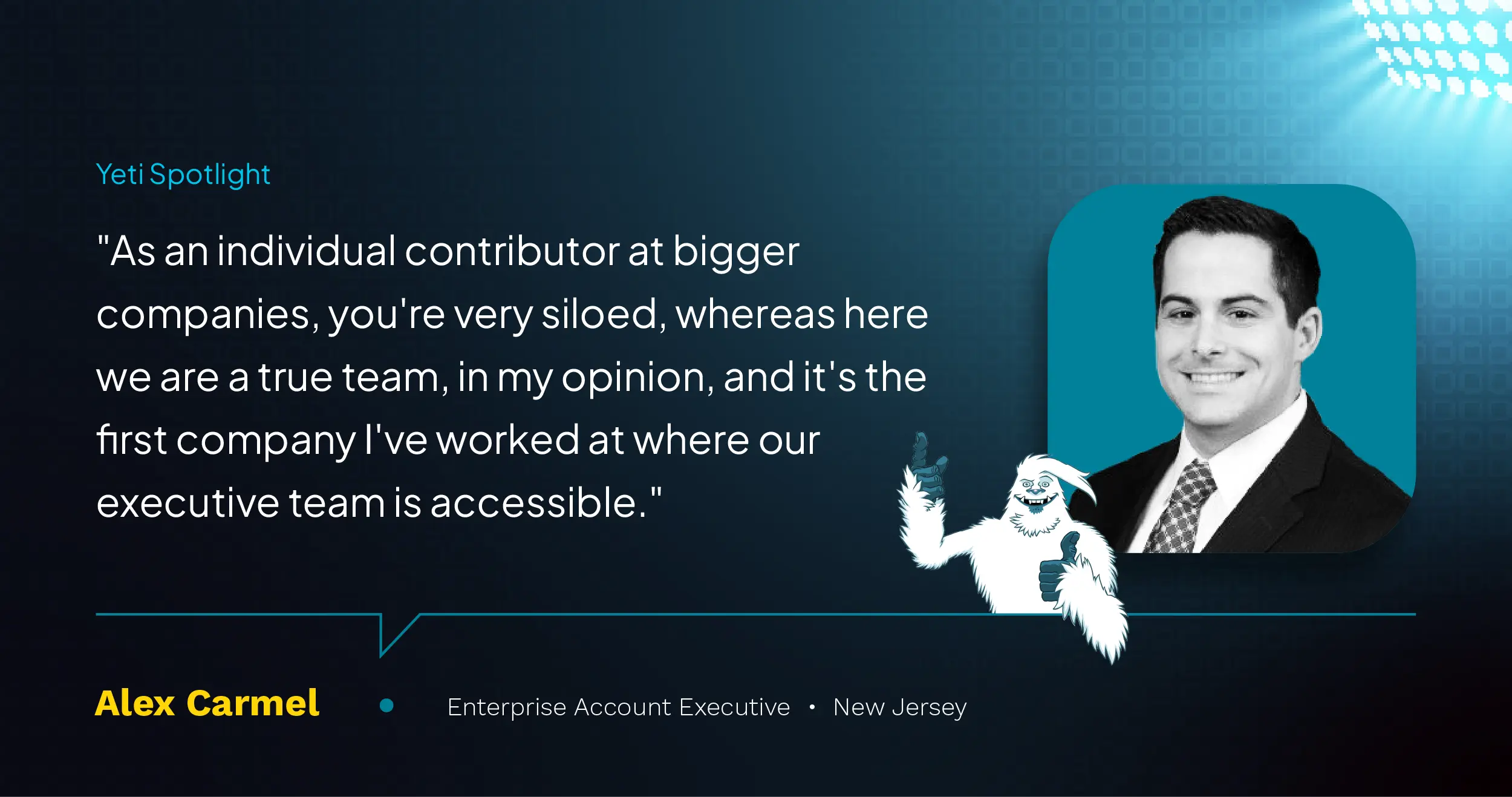
Alex Carmel is our driven Enterprise Account Executive! He enjoys problem-solving with prospects and thrives when navigating complex customer challenges. Alex was inspired to get into sales by his dad; his first job out of college was selling Body Armor drinks “door-to-door” to convenience stores, an experience that sharpened his interpersonal skills and built grit. He works closely with his team to drive success and is eager to help others because he believes sales is a team sport. Outside of work, Alex is a family man. When he’s not caring for his two toddlers, he enjoys exploring new restaurants, snowboarding, traveling, or playing in his beer hockey league.
Read on to learn why Alex values runZero’s unique culture, a place where leadership is accessible, teamwork is essential, and people come first!
Q&A
►What do you love most about your job?
I think the most exciting part of selling, especially at a startup like runZero, is that you’re the face of the company to the customer. I get to meet a lot of interesting people, and regardless of a customer’s use case, it’s problem-solving. I enjoy navigating the complexities and even the politics of these bigger companies.
As a sales rep, every day is different to some degree. That's what gets you up in the morning - it’s the excitement of starting a new project - or when we have a customer we know we can help, the team dumps all the resources we can into making them successful and it’s fulfilling when that prospect becomes a customer or we complete a feature request super fast. I’m constantly learning new things and meeting new people with every project I take on, and I love it. Ultimately, I think everyone has the same problem in some way or another, but how they approach it, how they want to fix it, and how we can make that happen varies, and it’s probably the most exciting part of what I do.
►What makes runZero different than other organizations you've worked at?
Sales at runZero is synergistic; everyone has to come together and do their job for us to close a deal. I've never worked at a place where I could get the founder or the CEO to meet my customers, no matter how big the deal was. As an individual contributor at bigger companies, you're very siloed, whereas here we are a true team, in my opinion, and it's the first company I've worked at where our executive team is accessible. Everyone is clear on the ultimate goals of growing the company and becoming an industry leader.
Another thing that makes runZero different from other organizations is compassion. A unique example of this is the 10-year cliff on our equity, it sends the message that HD and leadership care about their people. You always hear profits over people. We have the inverse here. We’re not perfect, no company is, but leadership and employees really care.
►How do you balance your career and family?
It's tough. Honestly, there are times when you don't. There are times when you have to put your family first, and there are times when you have to put work first. So there's not an easy answer to that. I try to spend at least an hour and a half to 2 hours in the morning with them before I start my day, and unless I have something super pressing, normally my day ends at 5. I like that I can disconnect. I try to not look at my phone until my kids go to bed, but I am in sales... if someone calls, I'll pick up.. I appreciate that leadership provides us with the trust and flexibility to set our schedules. It allows me to be more present, and honestly, I do not miss going into the office.
►What was the last TV show that you watched?
Landman with Billy Bob Thornton. It's on Paramount Plus and has the same creators as Yellowstone. I never got into Yellowstone, but someone recommended Landman. I get about an hour a night of free time to myself. So I watch one episode a night. It was good. It would not be everyone's cup of tea, a lot of expletives, but it was interesting. I enjoyed it.
]]>
https://www.runzero.com/blog/dell-emc/How to find Dell EMC devices on your network2025-03-31T11:08:00-04:002025-03-31T00:00:00-04:00Dell published a security advisory for Dell Unity, Unity VSA, and Unity XT products vulnerable to complete system take over. Here's how to find potentially affected devices on your network.runZero Team
Latest Dell EMC vulnerabilities
On March 27th, 2025, Dell published a Security Advisory for Dell Unity, UnityVSA, and Unity XT products for multiple vulnerabilities that could allow a remote attacker to compromise affected assets.
CVE-2025-22398 is rated critical with a CVSSv3 base score of 9.8.
CVE-2025-24383 is rated critical with a CVSSv3 base score of 9.1.
CVE-2025-24381 is rated high with a CVSSv3 base score of 8.8.
What is the impact?
Successful exploitation of the vulnerabilities varies, but all are vulnerable to remote exploitation from an unauthenticated attacker. Exploitation of CVE-2025-22398 could lead to arbitrary command execution as the root user, which could result in a complete system take over. Exploitation of CVE-2025-24383 could lead to the deletion of arbitrary files, including critical system files accessible by the root user. Exploitation of CVE-2025-24381 could led to session theft and/or the ability to conduct phishing attacks.
Are updates or workarounds available?
Dell has released a security update in 5.5.0.0.0.5.259, which can be found on their website. They strongly advise customers to upgrade to the remediated version as soon as possible.
How to find EMC Unity assets with runZero
From the Asset Inventory, use the following query to locate potentially vulnerable assets:
os:"EMC Unity" AND osversion:<5.5.0.0.0.5.259
]]>
https://www.runzero.com/blog/visualize-and-prioritize-risk/New Release: Detect, Visualize, & Prioritize Risks Like Never Before2025-03-26T12:00:00-04:002025-03-26T12:00:00-04:00We’re thrilled to announce that new Risk Findings, Risk Prioritization Dashboards, and Risk Visualizations are now live in the runZero Platform!Brandon Turner
We’re thrilled to announce that new Risk Findings, Risk Prioritization Dashboards, and Risk Visualizations are now live in the runZero Platform!
Today's launch marks a new era in exposure management. You can read more about that here. Our goal is to more effectively manage the risk lifecycle, enabling you to find, prioritize, and remediate broad classes of exposures across internal and external attack surfaces, including those that evade traditional vulnerability scanners and external attack surface management solutions. By accelerating the detection and prioritization of the exposures that are most likely to be exploited, we can deliver better outcomes for you, our valued community.
These new capabilities cover the entire risk lifecycle, empowering you with clarity and context to prioritize critical issues and accelerate remediation like never before.
Risk Management Dashboard
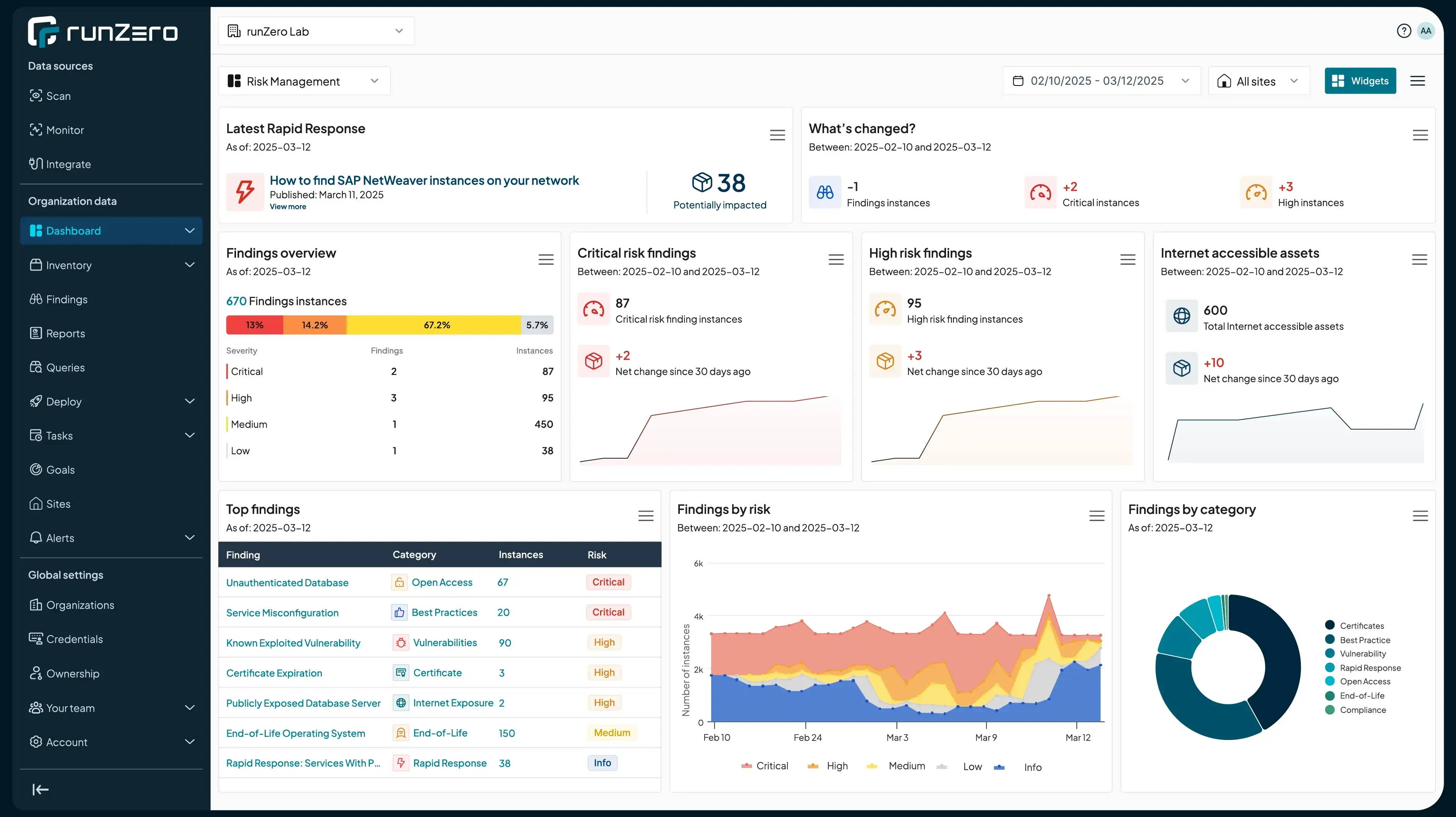
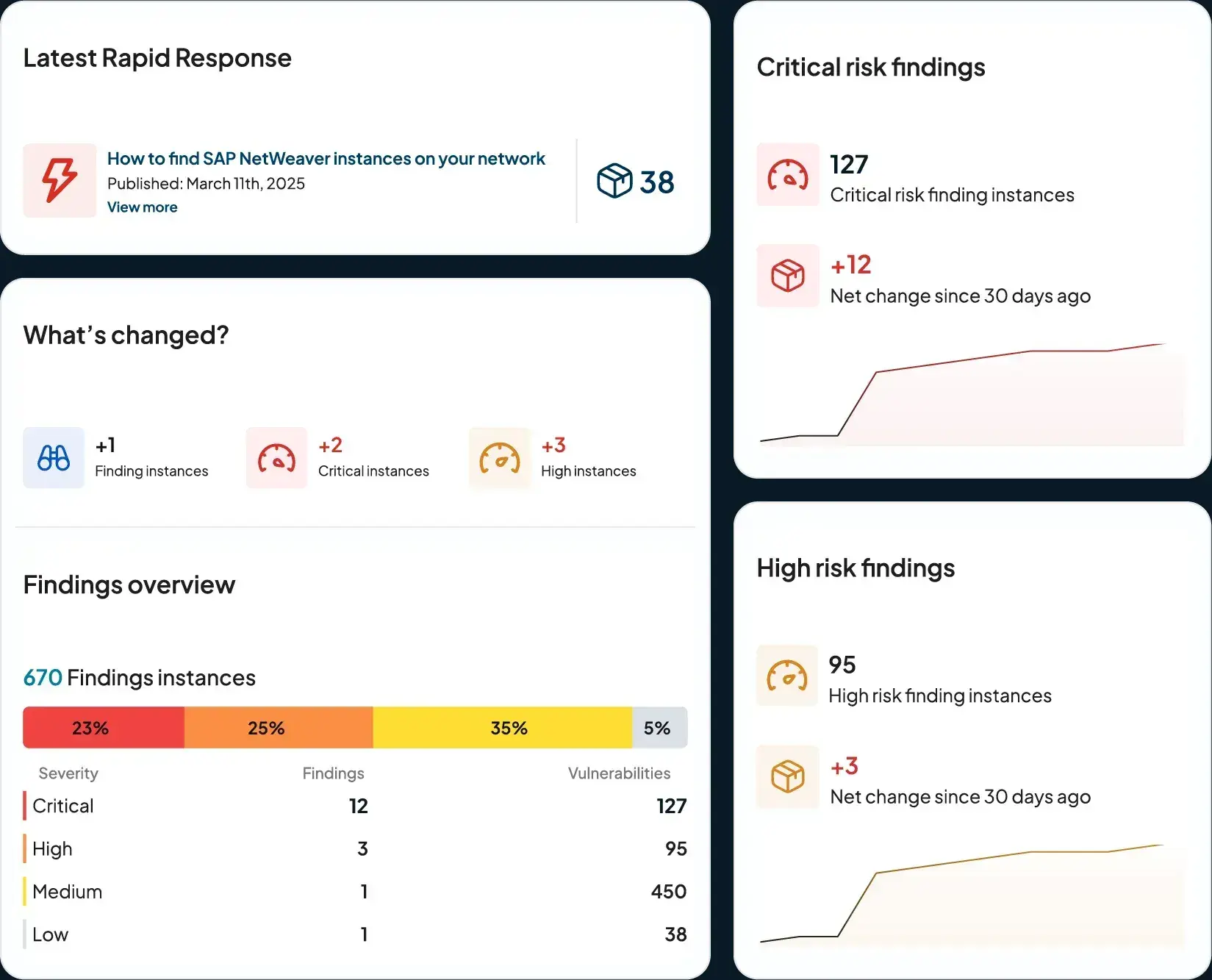
Your new command center for action. The Risk Management Dashboard is your centralized hub for taking action on risks, delivering actionable, data-driven insights with advanced findings widgets and customizable visualizations. As a cornerstone of runZero’s holistic exposure management, it provides comprehensive visibility and actionable context to help your team minimize exploitability windows, optimize resources, and reduce operational risks.
Key features include:
Latest rapid response alerts
Findings overviews with distributions
Critical findings and new alerts requiring action
Change tracking, including new assets
New finding categorizations with enhanced risk scoring
Customizable widgets for tailored visualizations and trend tracking
With these enhancements, the dashboard equips you to streamline exposure management with precision, effectiveness, and ease — all in one unified platform built for action.
New Risk Findings
Findings aren’t new to runZero, but how you interact with them is.
While our powerful search capabilities have always made risk data accessible, the new Findings Section take it to the next level — aggregating all instances affected by exposure categories and surfacing them in one place for fast, informed action.
This release streamlines the entire risk management and remediation lifecycle by organizing exposures by type, mapping them to affected assets and services, applying context-driven criticality, and enabling tracking over time.
We’re launching with eight categories of findings covering 22 unique issues, with rapid expansion planned over the next 12–18 months.
Our mission with Findings is simple: highlight the risks attackers actually target — those with real operational impact — and present them in a way that drives action. As we uncover new exposures, we’ll continue refining the dashboards to ensure every insight is both actionable and impactful.
Risk Findings Details
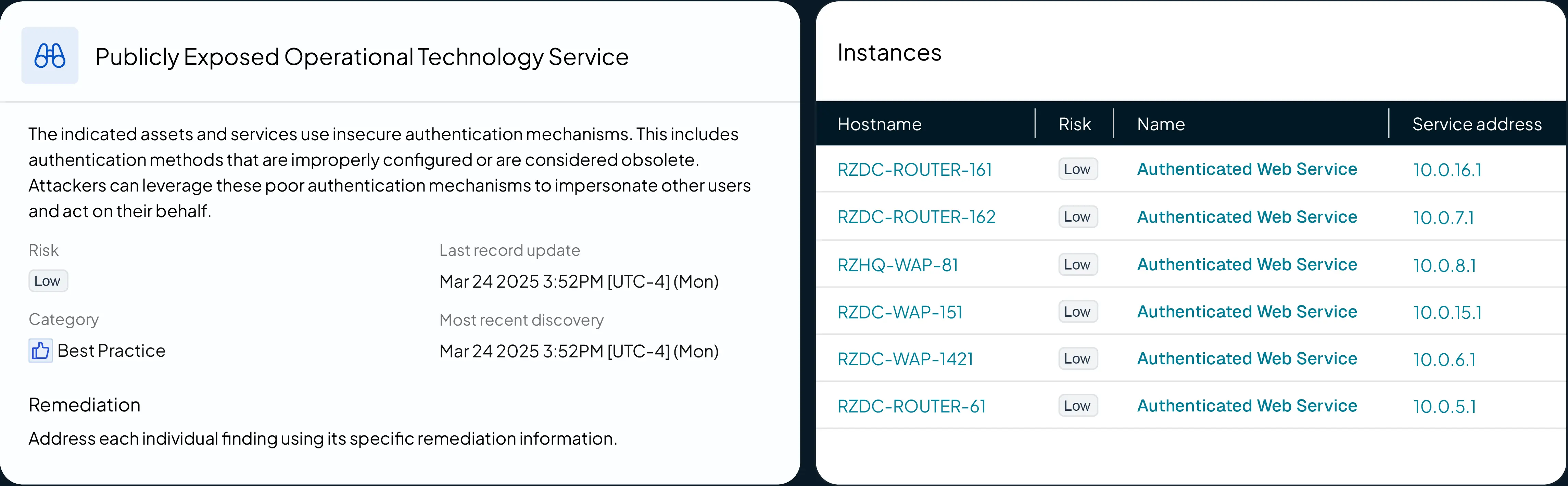
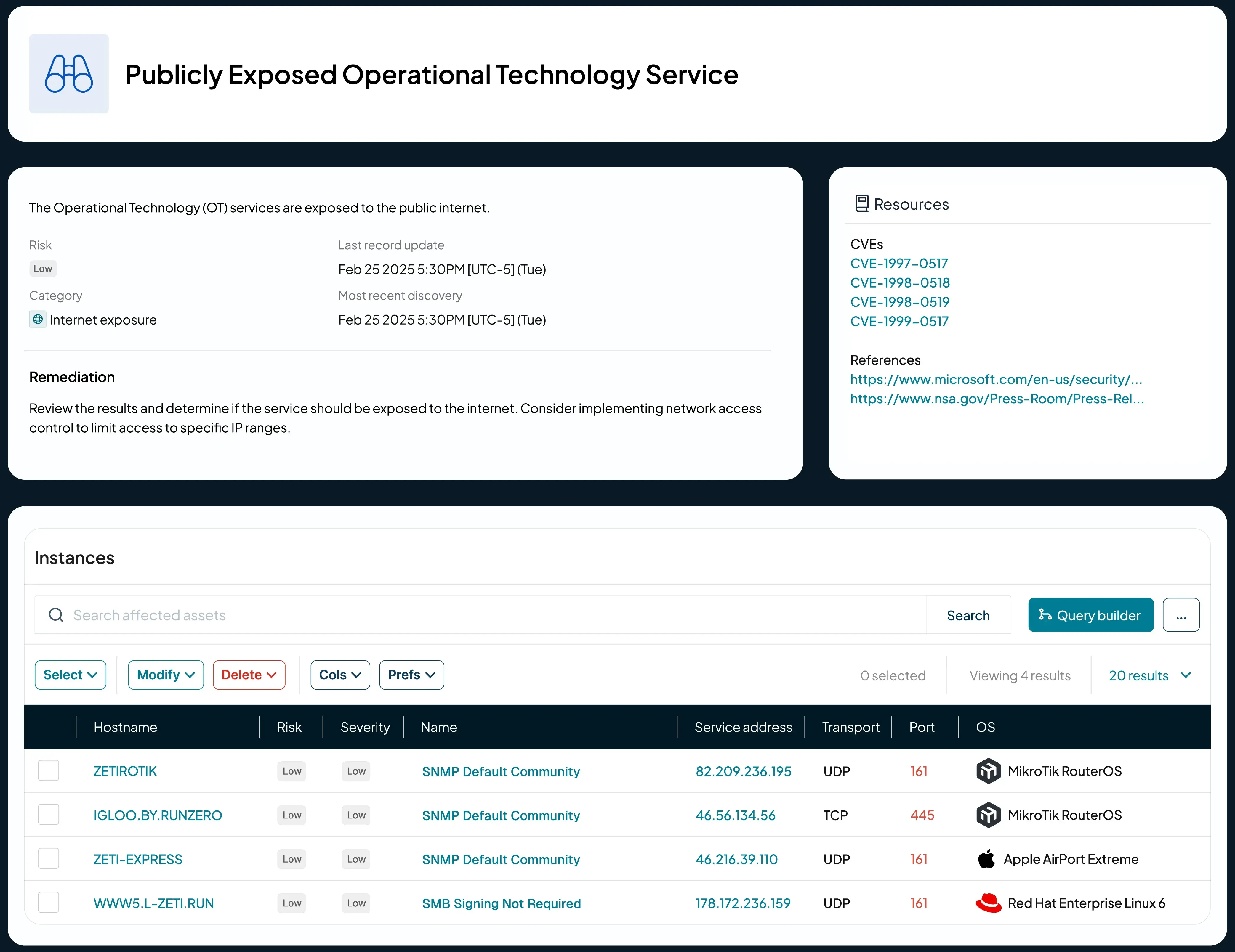
To delve deeper into risk findings, simply click on a higher-level categorization. For example, in the scenario below, you’ll find a category focused on publicly exposed operational technology (OT). Under "instances," you can easily search for data relevant to assets you want to prioritize or those with specific attributes. Each affected asset is clickable, allowing you to access detailed information about the device, including attributes uncovered through our advanced fingerprinting technology.
Risk Finding Categories
Internet Exposure
Identify internal assets that are unintentionally exposed to the public internet with runZero’s Inside-Out Attack Surface Management (IOASM) capabilities. This includes detecting systems that appear externally accessible based on indicators like MAC addresses, SSH banners, and TLS certificates. Sensitive services such as RDP, SSH with password authentication, SMB, VNC, and baseboard management controllers are also flagged.
Our initial release includes four key finding categories:
Potential external access to internal assets
Publicly exposed database servers
Publicly exposed operational technology services
Publicly exposed services
Certificates
runZero uncovers a wide range of security issues related to TLS certificates and SSH host keys. For example, it detects services with expired TLS certificates that aren’t being automatically rotated, an ongoing challenge for many overburdened operations teams. runZero not only alerts you to upcoming certificate expirations but also maps each certificate to all associated assets and services, making it easier to prioritize and deploy updates.
Our initial release includes two finding categories:
Expired TLS certificates
Widely shared private keys
Vulnerabilities
Identify assets affected by actively exploited CVEs using curated intelligence from the CISA Known Exploited Vulnerabilities (KEV) and VulnCheck catalogs. runZero helps you quickly pinpoint exposure to high-priority threats such as the HP iLO 4 authentication bypass, Microsoft OMI “OMIGOD” WSMAN exploit, OpenSSH 9.1p1 double-free, and VMware ESXi OpenSLP heap overflow.
Our initial release includes four key finding categories:
Known exploited vulnerabilities
Authentication bypass vulnerabilities
Denial of service vulnerabilities
Remote code execution vulnerabilities
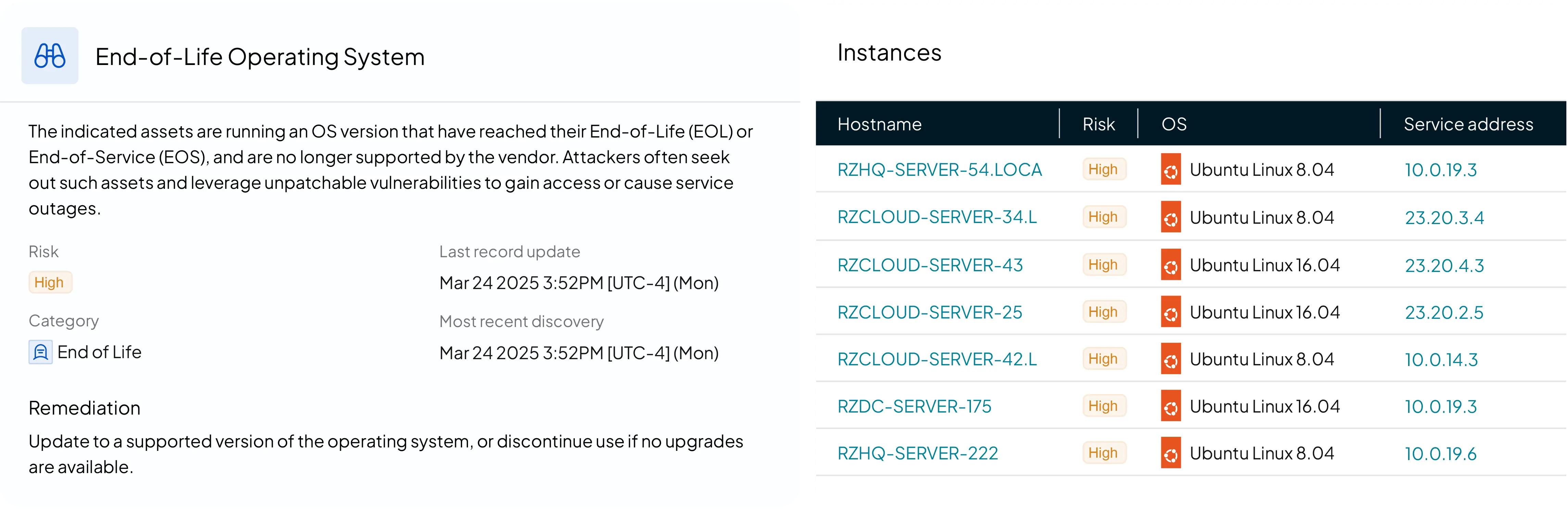
End-of-life
runZero detects assets running end-of-life (EoL) operating systems, hardware, and applications —critical gaps often missed in vulnerability management programs. With the wide variety of Linux distributions, Windows versions, and niche systems in IT, IoT, and OT environments, tracking EoL status can be a major challenge. runZero helps eliminate that blind spot by surfacing out-of-date assets, even in hard-to-reach corners of your environment. Examples include unsupported operating systems, legacy Accellion File Transfer Appliances, and Cisco Small Business Switches.
Our initial release includes two key finding categorizations:
End-of-life assets
End-of-life operating systems
Open Access
runZero uncovers network services that expose data or management functionality without requiring authentication, leaving organizations vulnerable to data leakage or unauthorized access. These exposures are often overlooked and can exist across a wide range of systems. Examples include open databases like Redis, MongoDB, and Elasticsearch, as well as services such as Android Debug Bridge, Cisco Smart Install, Distributed Ruby, and Zabbix Agent.
Our initial release includes three key finding categorizations:
Unauthenticated database
Unauthenticated service
File service accessible without authentication
Compliance
runZero flags assets that may put your organization out of compliance with common regulatory requirements. Whether mandated by government policy or industry standards, identifying prohibited software and hardware is essential for maintaining compliance and avoiding penalties. For example, runZero detects devices and services banned under the 2019 National Defense Authorization Act (NDAA) Section 889, as well as software from Kaspersky Lab, which is restricted for use in the United States and by U.S. persons.
Our initial release includes two key finding categorizations:
Prohibited software
NDAA 2019 Section 889 equipment
Best Practice Violations
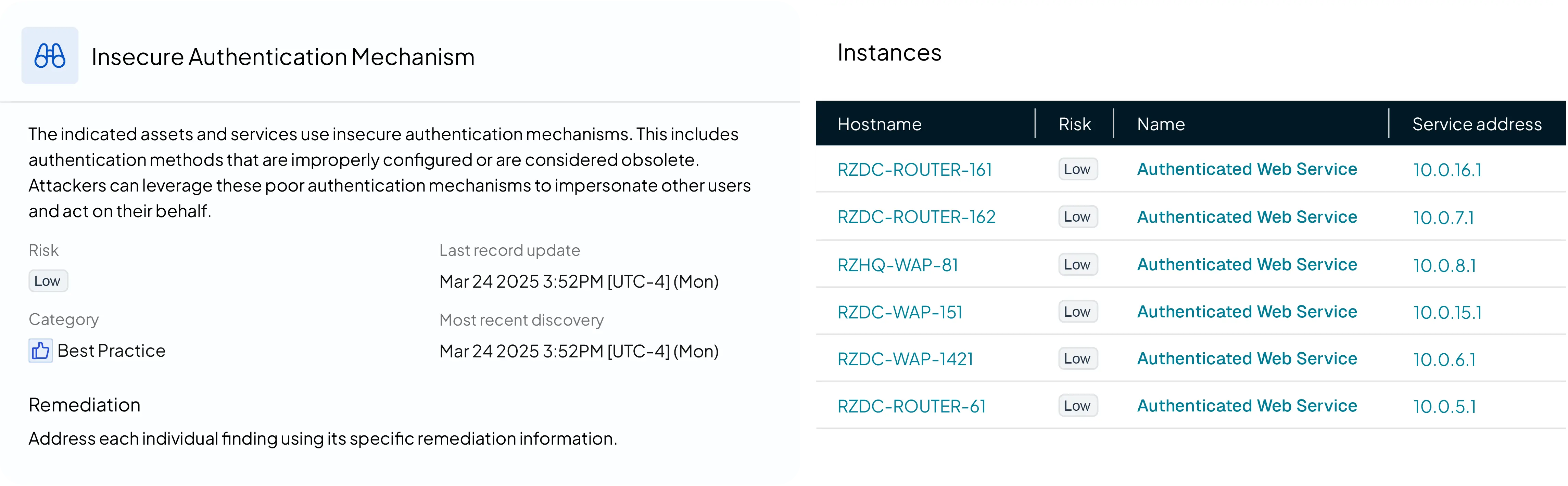
runZero identifies asset and service configurations that violate security best practices, many of which can lead to elevated risk if left unaddressed. These misconfigurations span a wide range of systems and services, from outdated protocols to weak authentication. Examples include SMBv1 enabled, SSL v2/v3 in use, and SNMP with default communities.
Our initial release includes three key finding categorizations:
Insecure authentication
Obsolete protocol
Service misconfiguration
Rapid Response
Stay ahead of emerging threats with runZero’s Rapid Response findings. As new zero-days, high-risk misconfigurations, and actively exploited services are discovered, runZero continuously runs curated queries to surface relevant exposures in real time. You’ll get immediate visibility into whether your environment is at risk — no manual searches required or delayed alerts to worry about.
We’re thrilled to share this release with you. These features are all available now in both our licensed runZero Platform and free Community Edition. Give them a try and tell us what you think! We love your feedback.
]]>
https://www.runzero.com/blog/new-era-exposure-management/Tackling the New Era of Exposure Management2025-03-25T21:00:00-04:002025-03-26T08:00:00-04:00Fixing what’s broken with legacy tools and overcoming decades-old problems requires a new approach. Dive into how we do it at runZero.runZero Team
Overcoming 25 Years of Vulnerability Mismanagement
Common Vulnerabilities and Exposures (CVEs) are the lingua franca of cybersecurity, providing unique identifiers to track the full lifecycle of security issues. From discovery through remediation, CVEs have become synonymous with exposure — but not all vulnerabilities have CVEs. Even when they do, only a very small percentage (0.05% according to the CISA KEV) are actually exploited, and regardless of the source of exploitation data, that observation is always days, weeks, or months behind.
Worse still, the tools we rely on to identify exposures often cover only a small subset of vulnerabilities, with their own significant delays — and even then, only reliably report these vulnerabilities under optimal conditions. Security teams are flooded with thousands of irrelevant alerts while still missing the most serious issues under active exploitation, ranging from default credentials to known-bad misconfigurations, open-access databases, and end-of-life software — all of which fly under the vulnerability management radar.
Traditional tools also fail to discover and defend unknown and unmanageable assets, providing insurmountable gaps from the beginning of the exposure detection and prioritization cycle. Starting with just a fraction of the attack surface makes it impossible to detect the full scope of exposure and prioritize it accordingly. The gaps are especially glaring in OT and IoT environments where agent-based and credential-dependent solutions aren’t feasible, leaving entire classes of assets and exposures invisible to traditional exposure management solutions.
With an incomplete and outdated view of the attack surface, it should come as no surprise that legacy solutions fail from the outset, leaving organizations vulnerable to risks hiding in the gaps, buried under irrelevant alerts, and invisible to traditional asset discovery and exposure detection methods. The resulting blind spots are precisely where the vast majority of attacks occur – in fact, only about 15% of breach events reported in the 2024 Verizon Data Breach Incident Report involved an exploited, CVE-identified vulnerability.
Fixing what’s broken with legacy tools and overcoming persistent, decades-old problems requires a new approach — one that uncovers the exposures you’ve been missing, encompasses your entire attack surface, and focuses relentlessly on surfacing the most exploitable issues. This is the big challenge we’re tackling at runZero. Let’s dive into how we do it and the new features we’re launching today.
runZero: Built for the new era of exposure management
Our goal is to empower security teams to fully manage the risk lifecycle: finding, prioritizing, and remediating all classes of exposures across internal and external attack surfaces, all in one place. As a single source of truth for exposure management, we believe runZero is the most effective and efficient way for organizations to proactively minimize risk across their entire attack surface. Let’s break down our approach.
Taking control of all assets across the total attack surface
As mentioned above, traditional tools fail from the start because they assess only a fraction of your actual attack surface. They miss unknown, unmanaged, and unmanageable devices while leaving entire classes of assets like OT, IoT, and mobile devices out of scope. With runZero’s proprietary methodologies, organizations discover every asset across IT, OT, IoT, mobile, and cloud environments safely and comprehensively.
How do we do it?
runZero combines active scanning, passive discovery, and API integrations to discover both internal and external attack surfaces, including elusive unknowns and unmanageable devices. If an asset is connected to your network, our Explorers will find it.
Our active scanning is proven safe for even the most fragile OT and IoT environments. We never send malformed packets and use incremental probing and detailed throttling to ensure safe and controlled scanning while gathering actionable information.
Our advanced fingerprinting delivers unmatched depth to identify critical insights into services, ownership, hygiene, and more (even screenshots!) — building detailed, accurate profiles of each asset, leveraging a library of almost 1,000 attributes.
We don’t rely on agents or authentication, providing comprehensive coverage and visibility with results in literally minutes.
The end result is total attack surface visibility — ensuring you see every asset on your network, no matter how hidden or unconventional. On average, runZero enterprise customers report finding 25% more assets than they were previously aware of, with some environments yielding 10x more assets than security teams expected, radically expanding their view of their attack surfaces and the exposures within. And this visibility also enables runZero to find risks well beyond CVEs and the reach of traditional tools.
Uncovering all types of exposures, including the hidden ones
Attackers don’t limit themselves to CVEs, and neither should your defenses. Our CAASM roots and industry-leading fingerprinting data give us an unfair advantage in being able to identify much broader classes of exposures, including those that evade traditional vulnerability and external attack surface management solutions.
Through context-rich data and detailed insights into device connections, configurations, and services, runZero reveals exposures that might otherwise remain hidden, including issues like network segmentation failures, externally-exposed internal assets, missing security controls, shared keys, end-of-life software, prohibited devices, and misconfigured OT and IoT devices.
runZero also enables you to quickly respond to zero days without rescanning. Leveraging data already captured in the fingerprinting process, embedded Rapid Responses enable you to immediately surface at-risk assets, including unmanaged devices.
With runZero, you can zero in on the critical exposures that attackers love to exploit.
Bringing the real threats into focus
Alert fatigue is a real thing, and today’s tools are responsible. Security teams are overwhelmed by irrelevant alerts, buried in noise that obscures true risks and delays remediation. Entire classes of tools have emerged simply to help teams prioritize the flood of alerts. And every delay gives attackers more opportunity for exploitation.
Our goal is to offer richer, more meaningful asset and exposure data that effectively prioritizes the risks that truly put your organization in danger. runZero performs this prioritization against a full-spectrum of exposure detection that includes your entire attack surface, not just a siloed swath.
runZero employs data-driven risk prioritization, highlighting the most urgent exposures by leveraging business context, device impact, and meaningful attributes. With highly intuitive risk findings, security teams can focus on critical threats while understanding their broader implications across the attack surface.
Armed with contextual data from runZero, security teams can accelerate remediation workflows and shrink exploitation windows, acting quickly and strategically while gaining operational efficiency.
Meet runZero Risk Findings: A new way to detect exposures and track risk
runZero’s new Risk Findings(and beautiful new dashboards) change the game by introducing a new paradigm for organizing and addressing exposures. They provide the focus and comprehensive coverage where traditional tools falter.
runZero Risk Findings identify classes of risk across your attack surfaces, aggregating all associated inventory assets, services, or other entities under each risk category. For example, a finding like “End-of-Life: Operating System” would automatically link all assets running unsupported operating systems, giving teams an actionable and organized way to target their remediation efforts.
But the enhancements go further. Findings don’t just present a current view of risk—they also provide a way to track trends over time. In this initial release, teams can monitor aggregate counts of associated findings historically. Over time, we plan to expand this capability, providing detailed snapshots of findings during critical status transitions that enable teams to track progress more effectively and stay ahead of evolving risks.
Today’s release includes a diverse range of findings to address the most critical risk areas and elusive exposures, including:
Internet Exposures: Identifies internal assets unintentionally exposed to the internet, such as Remote Desktop services or sensitive OT devices.
End-of-Life Systems: Pinpoints all assets running unsupported hardware or software, like aging Cisco Small Business Switches or obsolete Windows versions.
Open Access Services: Detects misconfigurations like unauthenticated databases (e.g., MongoDB, Redis) or exposed management interfaces.
Known Exploited Vulnerabilities: Highlights assets targeted by active threats, leveraging insights from CISA KEV and VulnCheck KEV catalogs.
Compliance Challenges: Flags instances of prohibited equipment or configuration issues that violate specific acquisition regulations, such as NDAA Section 889 violations.
Certificates: Identifies a wide range of security issues with TLS certificates and SSH host keys, including expired (and nearly expired) certificates, as well as widely shared private keys.
Best Practices: Highlights asset and service configurations that violate security best practices such as SMBv1 enabled, SSL v2/v3 in use, and SNMP with default communities.
Vulnerabilities: Identifies multiple issues based on both natively discovered and externally imported vulnerabilities.
Rapid Responses: Automatically runs queries for emerging threats, and tracks the results in the Rapid Response findings category.
Our aim is to uncover the kinds of risks attackers routinely exploit that other solutions often miss. Leveraging the depth of runZero’s discovery and fingerprinting data in novel ways offers unprecedented clarity into the exposures that truly matter most, eliminating irrelevant noise and blind spots.
What’s next?
This is just the beginning. runZero’s Risk Findings and exposure management capabilities are evolving on a daily basis, delivering powerful insights to help organizations stay ahead of exploitable threats. With every enhancement, our goal is to provide you with the tools you need to protect your total attack surface and take action where it matters most.
Tune in to April’s runZero Hour for a deep dive on all the new platform capabilities. Register →
Now on demand: Omdia analyst webcast "Vulnerability management is broken: what's the fix?" Watch now →
]]>
https://www.runzero.com/blog/ingress-nightmare/How to find Kubernetes Ingress-NGINX Controller installations on your network2025-03-24T19:34:00-04:002025-03-24T20:00:00-04:00On March 24th, Wiz and Kubernetes disclosed a pre-authentication remote code execution attack chain. Here's how to find Ingress-NGINX controller installations on your network.todb
IngressNightmare: Kubernetes Ingress-NGINX Controller vulnerability
Today, Wiz released an advisory detailing an attack chain they’ve dubbed IngressNightmare, which, if left exposed and unpatched, can be exploited to achieve remote code execution by unauthenticated attackers. The advisory, covering five separate vulnerabilities, was published after a brief embargo period, once the Kubernetes folks got their patches together.
What's the impact?
At its core, IngressNightmare is a collection of four injection vulnerabilities (CVE-2025-24513, CVE-2025-24514, CVE-2025-1097, and CVE-2025-1098), tied together by a fifth issue, CVE-2025-1974, which brings the whole attack chain together. Notably, the attack does appear to depend on a clear shot to the admission controller for the Ingress-NGINX controller, which itself is an optional component that allows for Kubernetes-homed services to be reached from the wider network.
Kubernetes has released an update to address these vulnerabilities. Users are advised to update to version 1.11.5, 1.12.1, or any later version as quickly as possible.
How to find potentially vulnerable Ingress-Nginx services with runZero
From the Services Inventory, use the following query to locate potentially vulnerable systems:
(_asset.protocols:tls AND protocol:tls AND tls.issuer:="O=nil1" AND tls.subject:="O=nil2" AND tls.names:"%nginx%")
]]>
https://www.runzero.com/blog/next-js/How to find Next.js on your network2025-03-22T20:00:00-04:002025-03-22T20:00:00-04:00On March 22nd, Next.js disclosed an authentication bypass vulnerability. Here's how to find Next.js systems on your network.HD Moore
Latest Next.js vulnerabilities
On March 22nd, 2025, Next.js disclosed an authentication bypass vulnerability in the middleware layer. Exploitation is trivial and can be achieved by sending an extra HTTP header. For specifics, please see the research paper.
CVE-2025-29927 is rated critical with a CVSSv3 base score of 9.1.
What is the impact?
Successful exploitation of this vulnerability would allow a remote attacker to bypass security checks implemented in the middleware layer, including many forms of authentication.
Are updates or workarounds available?
Next.js recommends that customers upgrade to 15.2.3 or 14.2.25. For users that cannot upgrade they recommend filtering the `x-middleware-subrequest` header from requests before they reach the application (case insensitive).
How to find Next.js installations with runZero
From the Service Inventory, use the following query to locate assets running any version of Next.js
_asset.protocol:http AND protocol:http AND (has:http.head.xPoweredBy AND http.head.xPoweredBy:="Next.js")
_asset.protocol:http AND protocol:http AND (
http.head.xPoweredBy:="Next.js" OR
http.head.vary:"Next-Router" OR
has:http.head.xNextjsCache OR
http.body:"/_next/static/"
)
]]>
https://www.runzero.com/blog/runzero-custom-integrations/Accelerate Asset Visibility with runZero's Custom Integrations2025-03-20T07:00:00-04:002025-03-20T07:00:00-04:00Boost asset management with runZero’s custom integrations framework—designed for fast, easy deployment to meet your unique tech stack needs.Tyler Diderich
As your company scales, customer expectations inevitably rise. With that in mind, achieving customer happiness means aligning your capabilities to their expectations—and when it comes to asset management, one size definitely does not fit all.
At runZero, we know customers love custom integrations because every company’s tech stack is unique. To help teams cover more ground faster, we’ve developed a custom integrations framework designed to make creating and deploying these integrations quick and easy.
The Power of the Custom Integration Framework
runZero's custom integration framework follows the classic 80/20 rule. You might already have core integrations that cover the majority of your common use cases—think common security tools, cloud services, EDRs, or MDMs. Yet, you'll inevitably encounter unique scenarios requiring custom solutions.
Recognizing this, we’ve created an easy-to-use custom integrations framework enabling customers to address those niche scenarios quickly. Instead of building everything from scratch, customers can leverage our validated GitHub repository with pre-built integrations. This dramatically shortens the integration development cycle.
But even validated integrations may need tailoring, and new integrations are always emerging. We want to make this as streamlined as possible for ourselves internally as well as our customers.
GPT Enters the Chat…
We went one step further and combined our custom integrations framework with GPT-powered automation. Introducing the runZero Custom Integrations Helper.
With this tool, you can significantly reduce your development time—think of it as the 80/20 rule in action again. Recently, I tested it by asking for a Cisco ISE integration without providing any initial context, and it delivered a nearly perfect integration right out of the gate.
Here's what we've observed:
Manual development time: Typically 4–8 hours.
With GPT assistance: Reduced to roughly 1–2 hours.
That’s a 75% reduction in effort, aligning neatly with the 80/20 rule of focusing effort where it matters most. This approach helps your engineering team focus more on strategic initiatives rather than routine integration builds.
Ultimately, the goal is simple—equip customers with the flexibility to rapidly build or customize integrations, streamline the integration process, and ensure that every unique requirement is met effectively.
We’re excited to see what you’ll build next. Feel free to contribute to our GitHub repo, or try the runZero Custom Integrations Helper to kickstart your next project.
Happy integrating!
]]>
https://www.runzero.com/blog/ibm-aix/How to find AIX systems running NIMSH on your network2025-03-19T15:47:00-04:002025-03-19T15:47:00-04:00Certain versions of IBM AIX contain vulnerabilities in the Network Install Manager (NIM) subsystem. Here's how to find affected assets with runZero.Rob King
Latest IBM AIX vulnerabilities: CVE-2024-56346 and CVE-2024-56347
Certain versions of IBM AIX (IBM's proprietary UNIX operating system) contain vulnerabilities in the Network Install Manager (NIM) subsystem. This subsystem is used to automate installation and configuration of AIX systems.
Successfully exploiting this vulnerabilities would allow an attacker to execute arbitrary code with administrative privileges on the affected systems. These vulnerabilities are assigned CVE-2024-56346 and CVE-2024-56347 and are considered extremely critical with CVSS scores of 10.0 and 9.6.
Are updates available?
IBM has released patch sets that address these vulnerabilities, and users are advised to update as quickly as possible. Additionally, users are advised to use network access controls to isolate potentially vulnerable systems and allow access only from trusted networks.
How do I find potentially vulnerable AIX systems with runZero?
AIX systems can be found by navigating to the Asset Inventory and using the following query:
os:AIX
]]>
https://www.runzero.com/blog/apache-tomcat/How to find Apache Tomcat instances2025-03-19T11:00:00-04:002025-03-19T11:00:00-04:00Certain versions of Apache Tomcat contain a vulnerability in their handling of partial HTTP PUT requests. Here's how to find affected instances with runZero.Rob King
Latest Apache Tomcat vulnerability: CVE-2025-24813
Certain versions of Apache Tomcat contain a vulnerability in their handling of partial HTTP PUT requests. If exploited, this vulnerability could lead to remote code execution, information disclosure, or file injection vulnerabilities depending on server configuration.
This vulnerability has been assigned CVE-2025-24813 and has been rated highly critical with a CVSS score of 9.8.
While this vulnerability has been rated highly critical, it is important to note that Tomcat is not vulnerable in its default configuration. There have been reports that this attack is being exploited in the wild, but thus far all attacks appear to be via a well-known proof-of-concept that is not expected to work outside of a lab environment.
Are updates available?
Apache has released updates that address these vulnerabilities, and users are advised to update their installations as quickly as possible. Additionally, setting the default servlet to readonly (by setting readonly = true in the configuration, which is the default) will mitigate this vulnerability.
How do I find potentially vulnerable versions of Tomcat with runZero?
Apache ActiveMQ services can be found by navigating to the Software Inventory and using the following query:
_asset.products:"Tomcat" AND product:"Tomcat" AND ((version:>=11.0.0 AND version:<11.0.3) OR (version:>=10.1.0 AND version:<10.1.35) OR (version:>=9.0.0 AND version:<9.0.99))
Results from the above query should be triaged to determine if they require patching or vendor intervention.
]]>
https://www.runzero.com/blog/ami-megarac-bmc/How to find AMI MegaRAC BMCs2022-12-05T13:30:00-05:002025-03-18T16:00:00-04:00AMI has disclosed a highly critical vulnerability in its MegaRAC SPx Baseboard Management Controller (BMC). Here's how to find affected assets with runZero.Rob King
Latest AMI MegaRAC BMC vulnerabilities
AMI has disclosed a vulnerability in its MegaRAC SPx Baseboard Management Controller (BMC). BMCs provide capabilities for remotely managing and monitoring servers. This vulnerability is considered highly critical with a CVSS score of 10.0. This exploit could allow a remote attacker to bypass authentication and take complete control of the vulnerable system. This issue was discovered and reported by Eclypsium Research, and is assigned CVE-2024-54085.
What is the impact?
A remote attacker capable of exploiting this vulnerability would be able to take complete control of the vulnerable system, potentially including the hosted operating system.
Are updates or workarounds available?
AMI has released updates to the vulnerable software; additionally users are strongly advised to implement network access control to limit access to BMC interfaces to trusted networks only.
How to find potentially vulnerable systems with runZero
From the Asset Inventory, use the following query to locate systems running potentially vulnerable software:
CVE-2023-34329 can be exploited with specially crafted HTTP headers to trick the Redfish service into believing the request is coming from an interface that does not require authentication, such as USB0. On systems which have the No Auth option enabled, these spoofed headers will allow attackers to access and interact with any Redfish API endpoints.
CVE-2023-34330 can be exploited via an HTTP POST action to execute arbitrary code on the MegaRAC processor. While this code-execution-via-POST was an intentional design choice by AMI, it likely was intended for internal development only. However, it is enabled by default in vulnerable versions of the firmware, making it available to a broader audience.
Chaining exploitation of the two above vulnerabilities together can provide attackers with unauthenticated remote code execution and full control over a vulnerable MegaRAC target. Following successful exploitation, attackers can establish persistence, perform data exfiltration, perform lateral movement in the network, deploy malware, and more. Attackers can also perform a denial of service by forcing the server into a reboot loop or even bricking the system so it will no longer properly function.
Are updates available?
AMI has made patched firmware available in versions SPx_12.4 and SPx_13.2. Admins should update MegaRAC BMCs to the newer firmware as soon as possible.
Eclypsium Research also shared mitigations to help reduce the chance of a successful attack, including:
Ensuring all remote server management network interfaces are NOT exposed externally and operate on networks dedicated to management traffic only.
Ensuring access to remote server management network interfaces is restricted to administrative users via ACLs or firewalls per Zero Trust Architecture principles.
Results from the above query should be triaged to verify if those assets are running updated firmware versions.
As always, any prebuilt queries are available from your runZero console. Check out the documentation for other useful inventory queries.
Severe flaws in MegaRAC baseband management firmware impacted servers from AMD, ARM, HPE, Dell, others
In December 2022, researchers with Eclypsium shared findings on three vulnerabilities present in American Megatrends (AMI) MegaRAC firmware.
MegaRAC can be found in many server manufacturers’ Baseboard Management Controllers (BMCs), including AMD, Ampere Computing, ASRock, Asus, ARM, Dell EMC, Gigabyte, HPE, Huawei, Inspur, Lenovo, Nvidia, Qualcomm, Quanta, and Tyan. Successful exploitation of these vulnerabilities can provide an attacker with remote code execution, an administrative shell, and user enumeration. Given American Megatrend’s broad reach across server manufacturers and models the number of systems with vulnerable MegaRAC BMC firmware could be quite large.
What was the impact?
These vulnerabilities were scored as CVSS “critical” and “high” severities, and the reported vulnerability details include:
CVE-2022-40259 (CVSS “critical” score of 9.9) - Remote code execution via Redfish API; requires initial access to an account with callback privileges or higher
CVE-2022-40242 (CVSS “high” score of 8.3) - Administrative shell via default credentials
CVE-2022-2827 (CVSS “high” score of 7.5) - User enumeration via API request manipulation
The Eclypsium report mentioned that public exposure of vulnerable BMCs appears to be “relatively low compared to recent high-profile vulnerabilities in other infrastructure products.” That said, data centers where many similar servers exist -– including data centers providing cloud-based resources -– could yield many opportunities for an attacker who has attained access, and detection of BMC exploitation can be “complex” and is likely to be missed with traditional EDR/AV.
Are updates available?
Mitigations are offered in the Eclypsium report (see the “Mitigations” section), including (but not limited to) the following suggestions:
Ensure that all remote server management interfaces (e.g. Redfish, IPMI) and BMC subsystems in their environments are on their dedicated management networks and are not exposed externally, and ensure internal BMC interface access is restricted to administrative users with ACLs or firewalls.
Review vendor default configurations of device firmware to identify and disable built-in administrative accounts and/or use remote authentication where available.
How do I find MegaRAC BMC assets running MegaRAC firmware?
From the Asset Inventory, use the following pre-built query to locate BMC assets running MegaRAC firmware which may need remediation:
As always, any prebuilt queries are available from our Queries Library. Check out the library for other useful inventory queries.
]]>
https://www.runzero.com/blog/schneider-electric/How to find Schneider Electric devices on your network2025-02-28T11:53:00-05:002025-03-18T15:00:00-04:00Schneider Electric ICS advisories address vulnerabilities in Modicon PLC, EPAS, and ASCO Remote Annunciator, including CVE-2024-11737, CVE-2025-0002, and more.todb
Latest Schneider Electric vulnerabilities
Our friends at CISA released advisories for a number of Schneider Electric ICS devices today through their Industrial Control Systems Advisories service, touching on Schneider Electric EcoStruxure Power Automation System (EPAS) (CVE-2025-0813, CVE-2025-1960, and CVE-2025-0002), ASCO Remote Annunciator (CVE-2025-1059), and Modicon PLC (CVE-2024-11737).
If you're in the business of power generation and distribution, you'll want to take a look at these. That said, all but one of these issues seems to come with some pretty convoluted attack scenarios, so you shouldn’t worry too much about them. However, the Modicon bug, CVE-2024-11737, is a protocol-level Modbus vulnerability, and does look worth worrying about, so read on for that.
What is the impact?
CVE-2024-11737 is a vulnerability in how Modicon Controllers M241, M251, M258, and LMC058 parse malformed Modbus packets. In most cases, this can cause the device to go offline, but if the attacker is particularly crafty with their packets, it can lead to total system compromise with remote code execution.
Are updates or workarounds available?
Schneider Electric has released an update for the M241 and M251 firmware for Modicon, and version 5.2.11.29 fixes the issue.
Unfortunately, there is no fix available yet for Modicon M258 and LMC058, but the usual advice applies: don't connect these devices to an untrusted network, use firewalls to filter IPs and affected Modbus ports, and if you're not expecting to use Modbus functionality, turn it off on affected devices.
How to find potentially vulnerable Schneider Electric devices with runZero
From the Asset Inventory, use the following query to locate systems running potentially vulnerable firmware:
hw:="Schneider Electric M241" OR hw:="Schneider Electric M251" OR hw:="Schneider Electric M258" OR hw:="Schneider Electric LMC058"
January 2025: M580 and Quantum Modicon communications adapters
Schneider Electric has reported a critical vulnerability in its M580 and Quantum Modicon communications adapters. These adapters are used in industrial control systems to allow communication with industrial control devices via industrial Ethernet.
This vulnerability is rated highly critical, with a CVSS score of 9.8.
The following devices are affected
Modicon M580 communication modules BMENOC BMENOC0321, versions prior to SV1.10
Modicon M580 communication modules BMECRA BMECRA31210, all versions
Modicon M580/Quantum communication modules BMXCRA BMXCRA31200, all versions
Modicon M580/Quantum communication modules BMXCRA BMXCRA31210, all versions
Modicon Quantum communication modules 140CRA 140CRA31908, all versions
Modicon Quantum communication modules 140CRA 140CRA31200, all versions
What is the impact?
Successfully exploiting this vulnerability would allow an attacker to take complete control of the vulnerable system. This vulnerability can be exploited remotely and without authentication.
Are updates or workarounds available?
Schneider Electric has released an update for the affected BMENOC modules. The BMECRA, BMXCRA, and 140CRA modules do not currently have updates available.
Users are advised to update as quickly as possible for any affected BMENOC modules. Users are also advised to isolate any potentially vulnerable modules from untrusted networks; in particular, UDP ports 67 and 68 should be blocked from unauthorized traffic.
How to find potentially vulnerable Schneider Electric devices with runZero
From the Asset Inventory, use the following query to locate systems running potentially vulnerable firmware:
hw:"Schneider%BMENOC" OR hw:"Schneider%BMXCRA" OR hw:"Schneider%BMECRA" OR hw:"Schneider%140CRA"
]]>
https://www.runzero.com/blog/eol-consumer-iot-labelling/Labelling for End-of-Life Consumer IoT2025-03-14T13:28:00-04:002025-03-14T13:28:00-04:00IOT labelling is back on the menu, but how to actually do it is still tricky.Rob King
Yesterday, Rob and Tod dug into the details of some proposed language for IoT labelling for End-of-Life (EOL) and End-of-Service (EOS) devices proposed by our friends at the Center for Democracy and Technology (CDT) and other consumer advocacy groups.
The language is especially concerned about labelling for kidtech and medtech, and wants vendors to be more responsible for letting people know when their IoT toys, medical gear, and assorted other internet-connected doo-dads won't be supported with security and usability patches and updates.
You can read lots of opinions on this topic, including ours, at the Dark Reading article by Arielle Waldman, but to expand a little more on our concerns here, I wanted to jot down some things to keep in mind when thinking about how EOL/EOS actually works when it comes to labelling and handling it in your environment.
Notionally, it's a good idea to label consumer tech with an EOL/EOS date, but the devil will absolutely be in the details of how that will actually work. After all, you probably want to know that your Thing of the Internet will be vendor-supported tomorrow if you buy it today. Practically, though, it gets complicated, and fast. Every such Thing made today has a software stack, that in turn is often drawn from dozens to hundreds of open source projects. These software sources, the hardware assembler (who is usually the "vendor"), and the retailer all have to agree on pushing out a patch or update.
Here in infosec, we need to really internalize the idea that just because something is missing a patch doesn't mean it stops working, so it's a sneaky fail case that's hard for consumers to even notice. At the same time, your home network and all the stuff attached to it is now often also touching your employer network, so keeping up on patching at home is becoming a corporate IT problem. With work-from-home, IT is responsible for the PlayStation in the CEO’s living room. Sophisticated attacks can target developers at home, and have, by subverting the usual write code-compile-ship workflow at the "write code" part.
As far as the actual notification mechanism is concerned, while physical labelling on docs and the device can be helpful, we need to appreciate that the secondary market -- selling your stuff on eBay or donating it to Goodwill -- will break the relationship between customer and vendor, making timely notification (such as by warranty card) that much more difficult. Besides, just because a vendor tells you when the EOL date is doesn’t mean they have to tell you how to keep patched, or make it easy. Autoupdates can help, until the autoupdate service itself goes EOL. And these EOL/EOS dates aren't set in stone -- some vendors will backport patches (Microsoft) past EOL if it's really serious. Some don't (F5 nginx), and require you to update.
So, I'm super curious to see where this model language goes and if we'll make some headway in being open and transparent about the realities of maintaining old tech on your home network. Of course, that's an especially relevant question if your home network is so close to your employer's network. After all, if you're a knowledge worker in America today, your aging internet devices are really starting to become your CISO's problem.]]>
https://www.runzero.com/blog/gitlab-instances/How to find GitLab instances2022-02-28T03:00:00-05:002025-03-13T00:00:00-04:00GitLab issued a new critical patch release to resolve a SAML vulnerability in GitLab software.runZero Team
Latest GitLab vulnerability (CVE-2025-25291, CVE-2025-25292)
GitLab has issued critical patch releases to resolve another Security Assertion Markup Language (SAML) authentication bypass vulnerability that affects self-hosted instances of both GitLab Community Edition (CE) and Enterprise Edition (EE). The vulnerability isn't specific to GitLab however. The root issue resides within an open source Ruby library that GitLab uses to handle SAML authentication requests.
CVE-2025-25291 and CVE-2025-25292 are rated critical with CVSS score of 8.8, and potentially allows for an attacker to bypass SAML authentication.
What is the impact?
According to GitLab, successful exploitation of this vulnerability allows for an attacker to gain access to a self-hosted GitLab instance, if configured to provide authentication using SAML. They have also noted that an attacker would need to have "comprised a valid user account to perform the authentication bypass".
Are updates or workarounds available?
For customers running self-hosted instances of GitLab, patches are available for download through their website. GitLab is advising customers running self-hosted instances to "upgrade to the latest version as soon as possible". If unable to patch the systems, the security advisory also includes mitigation instructions, which consist of enabling two-factor authentication and disabling the SAML two-factor bypass settings within GitLab. They also recommend requiring "admin approval for automatically created new users".
For more information, refer to the Security fixes of the patch release linked above.
For customers subscribed to GitLab's SaaS product (gitlab.com), no additional action is required.
How to find potentially vulnerable systems with runZero
From the Software Inventory, use the following query to locate systems running potentially vulnerable software:
product:gitlab and ((version:>17.9 and version:<17.9.2) or (version:>17.8 and version:<17.8.5) or (version:>17.7 and version:<17.7.7))
September 17, 2024 (CVE-2024-45409)
GitLab has issued a critical patch release to resolve a Security Assertion Markup Language (SAML) authentication bypass vulnerability that affects self-hosted instances of both GitLab Community Edition (CE) and Enterprise Edition (EE). The vulnerability isn't specific to GitLab however. The root issue resides within two open source Ruby libraries that GitLab uses to handle SAML authentication requests.
CVE-2024-45409 is rated critical with CVSS score of 10.0, and potentially allows for an attacker to bypass SAML authentication.
What is the impact?
According to GitLab, successful exploitation of this vulnerability allows for an unauthenticated attacker to gain access to a self-hosted GitLab instance, if configured to provide authentication using SAML.
Are updates or workarounds available?
For customers running self-hosted instances of GitLab, patches are available for download through their website. GitLab is advising customers running self-hosted instances to "upgrade to the latest version as soon as possible". If unable to patch the systems, the security advisory also includes mitigation instructions, which consist of enabling two-factor authentication and disabling the SAML two-factor bypass settings within GitLab. For more information, refer to the Security fixes of the patch release linked above.
For customers subscribed to GitLab's SaaS product (gitlab.com), no additional action is required.
How to find potentially vulnerable systems with runZero
From the Asset Inventory, use the following query to locate systems running potentially vulnerable software:
product:gitlab
September 11, 2024 (CVE-2024-6678)
On September 11, GitLab has issued a patch release for seventeen vulnerabilities that affect both GitLab Community Edition (CE) and Enterprise Edition (EE).
CVE-2024-6678 is rated critical with CVSS score of 9.9, and potentially allows for unauthorized resource access by an attacker.
In addition to the critical CVE, three high-severity vulnerabilities were also disclosed in the patch release.
CVE-2024-8640 is rated high with CVSS score of 8.5, which can lead to the remote execution of arbitrary code.
CVE-2024-8635 is rated high with CVSS score of 7.7, which can result in unauthorized access to resources.
CVE-2024-8124 is rated high with CVSS score of 7.5, which can result in a Denial of Service.
What is the impact?
According to GitLab, successful exploitation of this vulnerability allows for an attacker to "trigger a pipeline as an arbitrary user under certain circumstances".
Are updates or workarounds available?
For customers running self-hosted instances of GitLab, patches are available for download through their website. For customers already subscribed to GitLab's SaaS product (gitlab.com), no additional action is required.
How to find potentially vulnerable systems with runZero
From the Asset Inventory, use the following query to locate systems running potentially vulnerable software:
product:gitlab
February 2022 (CVE-2022-0735)
The development team at GitLab issued a new critical security release that patches seven recently-disclosed vulnerabilities in GitLab software. Reported by customers, security researchers, and GitLab team members, these vulnerabilities are located in various components of the software and affect both GitLab Community and Enterprise editions:
CVE-2022-0735 (CVSS "critical" score of 9.6) - Unauthorized users can steal runner registration tokens via quick actions commands
CVE-2022-0549 (CVSS "medium" score of 6.5) - Unprivileged users can add other users to groups via the API
CVE-2022-0751 (CVSS "medium" score of 6.5) - snippet content can be manipulated to display inaccurate/misleading data from an unauthorized user
CVE-2022-0741 (CVSS "medium" score of 5.8) - Environment variables can be leaked via sendmail
CVE-2021-4191 (CVSS "medium" score of 5.3) - User enumeration of private GitLab instances (with restricted sign-ups) can be possible by unauthenticated users via the GraphQL API
CVE-2022-0738 (CVSS "medium" score of 4.2) - User passwords can be leaked when adding pull mirrors with SSH credentials
CVE-2022-0489 (CVSS "low" score of 3.5) - A denial-of-service condition can be trigger by using the math feature with a specific formula in issue comments
Is an update available?
To avoid possible exploitation of the above vulnerabilities, GitLab recommends all admins update to GitLab versions 14.8.2, 14.7.4, and 14.6.5 for Community Edition (CE) and Enterprise Edition (EE) installations. If upgrading instances isn't viable in the near-term, GitLab does provide a hotpatch for the runner token disclosure vulnerability–the most severe vulnerability of the bunch–for a number of GitLab versions, suitable as a temporary mitigation until a full update can be performed.
How do I find potentially vulnerable GitLab instances with runZero?
From the Asset Inventory, use the following pre-built query to locate GitLab assets within your network that are potentially vulnerable:
product:gitlab
As always, any prebuilt queries we create are available from our Queries Library. Check out the library for other useful inventory queries.
]]>
https://www.runzero.com/blog/sap-netweaver-instances/How to find SAP NetWeaver instances on your network2022-02-11T03:00:00-05:002025-03-11T00:00:00-04:00SAP Issued a security advisory for several of their products including NetWeaver. Here's how to find instances running on your network.runZero Team
Latest NetWeaver vulnerabilities
On March 11th, 2025, SAP issued an advisory for several of their products including Commerce, Commerce Cloud and NetWeaver.
CVE-2025-26661 is rated high with a CVSSv3 base score of 8.8. Successful exploitation of this vulnerability could lead to privilege escalation and the potential disclosure of sensitive information.
What is the impact?
A missing authorization check within the ABAP Class Builder could allow an authenticated attacker, or malicious user to escalate their privileges, which could lead to the disclosure of sensitive information.
Are updates or workarounds available?
SAP has issued patches for all affected software. Refer to the advisory above for more information.
How to find NetWeaver installations with runZero
From the Asset inventory, use the following query to locate assets running any version of NetWeaver:
Some versions of SAP NetWeaver contain all three of these ICMAD vulnerabilities:
CVE-2022-22536 (CVSS "critical" score of 10.0) - vulnerable to request smuggling and request concatenation, successful exploitation by an unauthenticated attacker resulting in code execution, victim impersonation, data exfiltration, denial of service, and more. In addition to NetWeaver, some versions of SAP Web Dispatcher and SAP Content Server also contain this vulnerability.
CVE-2022-22532 (CVSS "high" score of 8.1) - vulnerability in shared memory handling, successful exploitation by an unauthenticated attacker resulting in code execution, victim impersonation, or taking over the victim's logon session.
CVE-2022-22533 (CVSS "low" score of 3.7) - vulnerability in error handling which could result in a denial of service attack by exhausting available memory, leading to system shutdown.
]]>
https://www.runzero.com/blog/inside-out-attack-surface-management/Inside-Out Attack Surface Management: Identify the risk before hackers bridge the gap2025-01-21T14:11:00-05:002025-03-10T15:00:00-04:00See how our new Inside-Out Attack Surface Management capabilities uncover risky and unexpected exposures that other solutions miss.HD Moore
In this blog article, we will walk through common scenarios that attribution-based attack surface management tools miss and demonstrate how you can use runZero's Inside-Out Attack Surface Management (IOASM) capabilities to close these gaps. IOASM helps you defend against opportunistic attacks by leveraging precise device fingerprinting to uncover exposures that are impossible to find through attribution alone.
The attribution challenge
Attackers are continuously scanning and prodding internet-facing systems, looking for easy wins. Although many campaigns start by knocking on your front door–testing assets clearly associated with your domain and IP space–attackers are just as likely to stumble upon an exposed system, compromise it, and only later realize it belongs to you. Opportunistic attacks drive an entire sub-category of the cyber-crime economy: initial access brokers. These criminal groups gain a foothold into your organization and then sell that access to other groups that steal data and attempt to extort money.
External attack surface management (EASM) tools (including runZero!) can reduce your risk by quickly flagging exposures before they can be exploited. You provide these tools with a list of domain names, IP addresses, autonomous system numbers (ASNs), and other identifiers, and the EASM attribution process will iterate on these "seeds" to identify internet-exposed assets. This process works great for well-known organizational resources, but often misses exposures where attribution is impossible using IP addresses and domain names alone.
Flipping the script with Inside-Out ASM
This is where Inside-Out ASM changes the game. While attribution-based EASM tools often struggle to identify exposures beyond their predefined "seeds," Inside-Out ASM flips the script by leveraging detailed knowledge of your internal assets to quickly and accurately identify external exposures, no matter where they are.
Instead of starting with known IPs or domains, the runZero Platform builds device fingerprints from attributes it gathers through external and internal active and passive discovery, as well as integrations with systems like cloud provider APIs and vulnerability scanners. This fingerprinting process captures details such as TLS certificates, SSH host keys, and SNMP metadata, in addition to other system-specific attributes, which tend to remain consistent even when a device changes IP addresses, network segments, or is redeployed from an image. By beginning with an internal baseline of these fingerprints, runZero can pinpoint each device’s unique identity deep within the environment, then correlate those same devices against information collected externally.
If an asset that was once detected in an isolated subnet suddenly appears on the internet—or if a device spins up in a public cloud and shares the same cryptographic fingerprint as one on-prem—runZero recognizes that it’s the same underlying system. This is why inside-out discovery is so effective: rather than relying on traditional attribution methods like IP ranges or domain registries, runZero focuses on inherent device characteristics.
Once a device’s fingerprint is known, any reappearance — be it behind corporate firewalls or exposed on a public IP — gets flagged, allowing security teams to see connections and gaps that external-only scans would miss. Through this inside-out lens, organizations can uncover at-risk assets faster and more accurately, significantly reducing blind spots that attackers often exploit.
To demonstrate, the scenarios outlined below highlight why attribution-based external attack surface management struggles with certain kinds of exposure and how Inside-Out ASM can help you find the blind spots.
Common scenarios missed by attribution-based EASM
1. The Legacy VPN
A global manufacturer migrated from per-site VPN gateways to zero-trust network access (ZTNA) using endpoint agents. After the migration was complete, the per-site VPN gateways were decommissioned. Unfortunately, the VPN gateway at a small branch office was never turned off. Months later, this gateway was compromised through a zero-day vulnerability in the SSL VPN function, allowing attackers to gain access to the corporate network. Worse, cached credentials dumped from the compromised gateway enabled further ingress into the network.
Why was this missed?
After migrating to ZTNA, the DNS records for the VPN gateways were removed. For small offices, the VPN gateways were connected through business broadband connections, and those IPs were not recorded in the organization's inventory or part of their EASM configuration.
How did runZero help?
A comprehensive internal discovery scan identified the legacy VPN gateway, leveraging runZero's advanced device fingerprinting to ensure no overlooked assets. The platform's ability to perform regular, automated scans ensures that similar devices are identified promptly, even if they are misconfigured or hidden in unexpected network segments. Once the gateway was flagged, an alert was configured to notify the security team if any similar devices appeared on the network in the future.
2. The Mobile Broadband Leak
A large financial organization issued laptops to their senior staff, each equipped with built-in mobile broadband cards (cellular modems). The intent was to ensure their team could stay connected even during transit, without relying on public WiFi. These Windows laptops were continuously connected to the mobile network and roamed between cellular providers, even while simultaneously connected to the corporate network through WiFi and wired Ethernet. Depending on which cellular provider was in use, these laptops would sometimes receive public IPv4 and IPv6 addresses, yet the firewall was not configured to block inbound connections. As a result, some portion of the senior staff's laptops were directly exposed to the internet on semi-random IP addresses. This, in turn, exposed the Remote Desktop and the SMB (CIFS) services to internet attacks. Fortunately, one of these systems was identified in the public Shodan search portal based on the organization's unique Active Directory domain, and the issue was resolved by deploying a group policy for Windows Firewall that always treated the mobile broadband connection as a public network.
Why was this missed?
Mobile broadband connections can vary dramatically by provider and location. Some providers place customers into private IP space, while others assign public IPs. In some cases private IPv4 addresses are assigned in addition to public IPv6 addresses. Attribution-based exposure management tools struggle to find these connections.
How did runZero help?
An internal scan identified the public IP addresses of these Windows laptops using a combination of unauthenticated NetBIOS (UDP) and DCEPRC (Oxid2Resolver), leveraging runZero's advanced asset fingerprinting capabilities to detect and categorize devices accurately. The platform's ability to conduct both internal and external scans ensured that no public IP addresses associated with these devices were overlooked, even as they roamed between cellular providers. A direct scan of these public IPs confirmed that the mobile broadband connections were exposing these machines directly to the internet, including the Remote Desktop and SMB services.
Additionally, runZero's automated inventory and exposure tracking ensured that any newly exposed IP addresses were promptly identified. An alert rule was configured to notify the security team whenever a Windows machine on the internal network was detected with a public IP address, enabling real-time monitoring of at-risk devices. This proactive visibility not only mitigated the immediate risk but also provided actionable insights for implementing policies to prevent future exposures, such as refining firewall rules and deploying group policies for Windows Firewall.
3. The "Smart" IP Camera
A national construction firm needed to install a camera in the lobby of their headquarters. They chose an IP camera made by Hikvision, one of the most prolific manufacturers and a type of device that is commonly sold under different brand names. This camera was "smart"; it could detect people and faces and send an alert when particular behavior was observed, such as someone loitering in the lobby after hours. Unfortunately, this camera was too smart; the default configuration caused it to open a hole in the firewall using the UPnP protocol and automatically port-forward several services from the internet to the camera. These services included the video service (RTSP), the web server used for device administration, and a few proprietary Hikvision services.
Shortly after installation, the camera was compromised using an off-the-shelf exploit that enabled remote, unauthenticated command execution through the web service. The attacker gained complete access to the camera and leveraged the Linux operating system shell to explore the company's internal network. The UPnP-enabled network gateway was an issue on its own, but the automatic port forwarding behavior of the camera escalated the situation into a full-blown crisis.
Why was it missed?
This is an example where EASM can help, but only if the issue was identified and mitigated quickly. EASM tools can be noisy, and investigating the results of new exposures can often take days or weeks to track down the appropriate owner.
How did runZero help?
An internal network scan combined with the Inside-Out ASM capability immediately flagged this system as being externally exposed and accurately matched the internal asset to its corresponding external exposure. runZero's advanced fingerprinting techniques ensured that the match was precise, even for devices with dynamic configurations or those hidden behind network complexities. By leveraging a combination of passive and active discovery, the platform provided comprehensive visibility into both internal and external networks.
Once the exposure was identified, an alert rule was created to notify the security team of similar vulnerabilities in the future. Additionally, runZero's integration capabilities allowed the organization to correlate this exposure with existing threat intelligence feeds, enabling the team to assess whether the exposed device had been targeted or exploited. This integration also streamlined remediation efforts by generating actionable insights, such as misconfiguration details and recommended mitigation steps.
4. The Developer Tunnel
A global retailer was developing a new version of their online store-front. This work was being coordinated across multiple groups worldwide, including several external contractors. A standard test environment was configured in the cloud, but deployments were taking too long. As a result, the development team began using "tunnel" software, such as Cloudflare Tunnel and ngrok.io, to share their work-in-progress from their developer machines with the wider group.
An attacker stumbled over one of these tunnels and identified a development console in the application that exposed all environment variables. These environment variables contained a wide range of credentials, including access keys to the production cloud account. Fortunately, rather than backdooring the application or stealing data, the attacker instead launched mining bots for cryptocurrency. The organization noticed the resulting cost spike, traced the leaked credential to the developer workstation, and implemented a policy prohibiting the use of tunnels going forward.
Why was it missed?
The internet-side of the tunnel can pop out almost anywhere, including common providers like Cloudflare and ngrok, as well as on virtual machines hosted by cloud providers like Digital Ocean and Linode. These endpoints have no known relationship to the organization’s domain or registered IP ranges, making them difficult to detect with attribution-based tools.
How did runZero help?
This is another example of how Inside-Out ASM was able to match the internal fingerprint of the web server to an externally exposed service on a tunnel provider. By leveraging advanced device fingerprinting, runZero ensured the match was precise, even for services hosted in dynamic or ephemeral environments like those created by tunnel software. This capability provided visibility into hidden or misconfigured exposures that traditional attribution-based methods would likely miss.
After identifying the exposure, an alert rule was configured to notify the security team of any similar issues in the future. Additionally, runZero’s ability to integrate with SIEMs and other security tools allowed the team to automate follow-up actions, such as blocking traffic to unapproved tunnel providers or initiating incident response workflows. The platform’s continuous monitoring ensured that new tunnels or services appearing in the environment were flagged immediately, reducing detection and response times.
Minimal noise and no real false positives
An important point to note is that Inside-Out ASM uses detailed fingerprints and a set of layered heuristics to determine if a match between an internal and external asset represents an exposure. This process isn't perfect, but even in cases where a match doesn't indicate a true exposure, it still highlights a risk. For example, if the same TLS certificate is found on an internal storage device and also observed on the internet, it could either mean this is the same device or that the device is using a hardcoded TLS key. runZero's heuristics automatically report duplicated and widely shared keys.
In addition to reporting shared keys, runZero also assigns varying severity levels based on the confidence of the match. For instance, if an internal web server is using aTLS certificate observed on the internet, and that certificate is signed by a valid authority, this is likely either the internal side of an internet-facing web server cluster or a case where the public TLS certificate is also used on internal systems. runZero will report this as a low-risk exposure. Conversely, if the match involves a Remote Desktop service or a SSH host key that is not widely shared, this is almost certainly a critical issue requiring immediate action, and the exposure is reported as high risk.
From theoretical to operational
While it’s easy for us to describe how runZero can detect these threats, it’s even better to show you how to do it in your own instance. The good news is that Inside-Out exposure detection is enabled by default for all runZero customers.
To get started, navigate to the Inventory -> Vulnerabilities section and search for “Potential External Access To Internal Asset” and “Private Key Is Widely Shared”. Any internal assets that runZero was able to identify externally, regardless of IP address or location, will be flagged with a vulnerability record based on the type of exposure.
The three exposure detection methods available today are:
TLS Certificate
SSH Hostkey
MAC Address
Clicking on the name of the vulnerability will open the details page:
This page provides a list of the public endpoints where this internal system was observed. As always, we would love your feedback! Drop us a line via hello@runzero.com if you have any suggestions. If you encounter any issues, reach out to our engineering team at support@runzero.com.
]]>
https://www.runzero.com/blog/edimax-ip-cameras/How to find Edimax IP cameras on your network2025-03-07T16:48:00-05:002025-03-07T16:48:00-05:00On March 7th, 2025, CISA disclosed a vulnerability in all versions of the Edimax IC-7100 network camera.Rob King
Latest Edimax Network cameras vulnerability: CVE-2025-1316
On March 7th, 2025, CISA disclosed a vulnerability in all versions of the Edimax IC-7100 network camera:
CVE-2025-1316 is rated critical with a CVSSv3 base score of 9.3. Successful exploitation of this vulnerability would allow a remote attacker to execute arbitrary code.
What is the impact?
Upon successful exploitation of this vulnerability, an attacker who could send unauthenticated requests to the camera could execute arbitrary code. All versions of the camera are affected.
Are updates or workarounds available?
There is currently no vendor-supplied update or patch for this vulnerability. Users are recommended to remove these cameras from their environment if possible, or isolate them using network access control mechanisms.
How to find Edimax cameras with runZero
From the Asset Inventory, use the following query to locate these cameras:
hw:"EDIMAX IC-71%Camera"
]]>
https://www.runzero.com/blog/elastic-kibana-2/How to find Elastic Kibana on your network2025-03-06T10:56:00-05:002025-03-06T10:56:00-05:00On March 5th, 2025, Elastic disclosed a vulnerability in multiple versions of Kibana. Here's how to find affected versions on your network.Tom Sellers
Latest Elastic Kibana vulnerabilities
On March 5th, 2025, Elastic disclosed a vulnerability in versions 8.15.0 to 8.17.2 of Kibana.
Note: Elastic indicates that the vulnerability is tracked as CVE-2025-25012 which is currently unlisted in the NIST NVD. NIST does seem to track this as CVE-2025-25015 so that is what we use below.
CVE-2025-25015 is rated critical with a CVSSv3 base score of 9.9. Successful exploitation of this vulnerability would allow a remote attacker to execute arbitrary code.
What is the impact?
Upon successful exploitation of this vulnerability, an attacker who could upload a file and execute a crafted HTTP request could execute arbitrary code. The rights required depend upon the version.
Kibana versions >= 8.15.0 and < 8.17.1, this is exploitable by users with the Viewer role
Kibana versions 8.17.1 and 8.17.2, this is only exploitable by users that have roles that contain all the following privileges: fleet-all, integrations-all, actions:execute-advanced-connectors
Are updates or workarounds available?
Elastic recommends that customers upgrade to Kibana version 8.17.3. For users that cannot upgrade they recommend implementing the following setting in Kibana's configuration:
xpack.integration_assistant.enabled: false
How to find Elastic Kibana installations with runZero
Vulnerable versions of Elastic Kibana can be found in the Software inventory using the following query:
product:kibana AND (version:>8.14 AND version:<8.17.3)
From the Asset Inventory, use the following query to locate assets running any version of Elastic Kibana:
product:kibana
]]>
https://www.runzero.com/blog/stormy-with-a-chance-of-runzero/Stormy with a chance of runZero2025-03-04T18:00:00-05:002025-03-04T18:00:00-05:00runZero and GreyNoise, together at last on Storm Watchtodb
Well, that was fun!
It's the the dawn of a new era in mid-week, mid-morning infosec gossip and shop talk! Today, Tod Beardsley, runZero's newly-minted VP of Research (that's me!), joined the crew of gobby experts featured on GreyNoise Intelligence's Storm⚡️Watch. We talked mostly about the Veracode, Dragos, and Huntress research reports, and you can catch the show notes over at the GreyNoise blog.
If you're unaware, Storm⚡️Watch is a weekly webcast and podcast where experts from GreyNoise, Censys, VulnCheck, and runZero get together to discuss, break down, and make bad puns about cybersecurity, information security, vulnerabilities, exploits, online scams, and all the rest.
Best of all, it's live streamed on YouTube, LinkedIn, and Twitch, and the chat is open. I've been a fan of this show for well over a year, specifically because it's so interactive and fun, so I'm super stoked to be able to hang out with my internet pals and try, desperately, to find the silver linings in the week's cyber storm clouds.
Check it out live on Tuesdays at 10:30am Boston / 9:30am Austin / 8:30am Idaho Falls / 7:30am Santa Cruz on your favorite video streaming services, or shortly after on your podcast app of choice. (Sadly, you'll have to search for "Storm Watch" without the ⚡️ emoji, but it should be the first hit.)
And if you don't happen to catch Tod on the next episode, never fear, you'll have your chance on the next runZero Hour, our own monthly webcast, featuring the beloved Rob King. Oh yes. That's going to be a blast, so get your registration in pronto. :)
]]>
https://www.runzero.com/blog/vmware-esxi/How to find VMware ESXi installations on your network2025-03-04T09:00:00-05:002025-03-04T10:00:00-05:00On March 5th, 2025, VMware disclosed several vulnerabilities in its ESXi, Workstation, and Fusion products.Rob King
Latest VMware ESXi vulnerabilities
On March 4th, 2025, Broadcom disclosed several vulnerabilities in all versions of its VMware ESXi, Workstation, and Fusion products. They also indicated that these are known to be exploited in the wild. Public information indicates that these vulnerabilities are potentially being leveraged by ransomware groups.
CVE-2025-22224 is rated critical with a CVSSv3 base score of 9.3. Successful exploitation of this vulnerability would allow a local administrative user in a guest virtual machine to execute arbitrary code as the guest virtual machine's VMX process on a vulnerable host system. Impacts VMware ESXi and Workstation.
CVE-2025-22225 is rated important with a CVSSv3 base score of 8.2. Successful exploitation of this vulnerability would allow a malicious actor with privileges within the VMX process to trigger an arbitrary kernel write leading to an escape of the sandbox. Impacts VMware ESXi.
CVE-2025-22226 is rated important with a CVSSv3 base score of 7.1. Successful exploitation of this vulnerability would allow a local administrative user in a guest virtual machine to leak memory from the VMX process on a vulnerable host system. Impacts VMware ESXi, Workstation, and Fusion.
What is the impact?
Upon successful exploitation of these vulnerabilities, an attacker with administrative rights in a guest virtual machine would be able to perform a VM Escape and execute code on the hypervisor host.
Are updates or workarounds available?
VMware has released updates for supported versions of the impact products to address these vulnerabilities. All users are urged to update as quickly as possible. Users of unsupported version should review the download portals for their product to see if Broadcom has made patches available. They have reportedly done so for VMware ESXi 6.5 and 6.7. That said, Broadcom strongly encourages all customers using vSphere 6.5 and 6.7 to update to vSphere 8.
From the Asset Inventory, use the following query to locate assets running vulnerable versions of VMware ESXi:
os:"vmware esxi" AND (os_version:<6 OR (os_version:>6 AND os_version:<"6.7.0 build-24514018") OR (os_version:>7 AND os_version:<"7.0.3 build-24585291") OR (os_version:>8 AND os_version:<"8.0.2") OR (os_version:>"8.0.2" AND os_version:<"8.0.2 build-24585300") OR (os_version:>"8.0.3" AND os_version:<"8.0.3 build-24585383"))
Additionally, using the runZero VMware integration, use the following Asset Inventory query to locate virtual machines running inside VMware, which could be potential sources of exploitation:
source:vmware
Vulnerable versions of Workstation and Fusion can be found in the Software inventory using the following query:
vendor:vmware AND ((product:Workstation AND version:<17.6.3) OR (product:Fusion AND version:<13.6.3))
All versions of Workstation and Fusion can be found in the Software inventory using the following query:
vendor:vmware AND (product:Workstation OR product:Fusion)
Multiple CVEs (June 2024)
Broadcom has disclosed a vulnerability in their ESXi product that involves a domain group that could contain members that are granted full administrative access to the ESXi hypervisor host by default without proper validation.
CVE-2024-37085 is rated medium with CVSS score of 6.8 and allows an attacker with sufficient Active Directory (AD) permissions to bypass authentication.
What is the impact?
A malicious actor with sufficient Active Directory (AD) permissions can gain full access to an ESXi host that was previously configured to use AD for user management by re-creating the configured AD group ('ESXi Admins' by default) after it was deleted from AD. The three ways this can be exploited are:
1. Creating the AD group 'ESX Admins' to the domain and adding a user to it (known to be exploited in the wild) 2. Renaming another AD group in the domain to 'ESX Admins' and adding a new or existing user to it 3. Refreshing the privileges in the ESXi hypervisor when the 'ESX Admin' group is unassigned as the management group.
How to find potentially vulnerable systems runZero
From the Asset Inventory, use the following query to locate systems running potentially vulnerable software:
os:ESXi
Additionally, using the runZero VMware integration, use the following query to locate virtual machines running inside VMware, which could be potential sources of exploitation:
source:vmware
Multiple CVEs (March 2024)
On March 5th, 2024, VMware disclosed several vulnerabilities in its ESXi, Workstation, and Fusion products.
The CVSS scores range from 7.1 (high) to 9.3 (critical); the vulnerabilities affecting ESXi are limited to high severity, but the vendor has indicated that taken together the vulnerabilities should be considered critical.
What is the impact?
Upon successful exploitation of these vulnerabilities, an attacker who can execute code inside a virtual machine can access the host system and perform actions ranging from arbitrary code execution to sensitive information disclosure.
Are updates or workarounds available?
VMware has released new versions of these products to address these vulnerabilities. All users are urged to update as quickly as possible.
How to find VMware installations with runZero
From the Asset Inventory, use the following query to locate assets running potentially vulnerable versions of VMware ESXi or running VMware products:
os:ESXi
Additionally, using the runZero VMware integration, use the following query to locate virtual machines running inside VMware, which could be potential sources of exploitation:
source:vmware
Additional fingerprinting research is ongoing, and additional queries will be published as soon as possible.
CVE-2021-21974 (February 2023)
In February 2023, popular hypervisor ESXi made the news due to fresh targeting by a new strain of ransomware. Known as ESXiArgs, this ransomware leveraged a 2-year old heap overflow issue in the OpenSLP service that can be used to execute remote code on exploitable targets (CVE-2021-21974). Many vulnerable public-facing ESXi servers had already been affected by this malware (at the time over 1,900 via Censys search results).
What was the impact?
Targets of this new ransomware campaign were older ESXi servers running certain versions of 6.5, 6.7, or 7 releases and also had the OpenSLP service enabled (it has not been enabled by default in ESXi releases since 2021). Upon successful exploitation of CVE-2021-21974, the ESXiArgs ransomware encrypted a number of file types on the target system, including VM-related files with extensions .vmxf, .vmx, .vmdk, .vmsd, and .nvram. Ransom notes were saved as HTML files on compromised systems for admins and users to subsequently discover. While some of these ransom notes claim to have stolen data from vulnerable targets, no data exfiltration had been observed at the time.
VMware made patches available when the OpenSLP heap-overflow vulnerability was initially reported in 2021. The following ESXi releases had been patched against this attack vector and exploited by the ESXiArgs campaign:
ESXi version 7+ (ESXi70U1c-17325551 and later)
ESXi version 6.7+ (ESXi670-202102401-SG and later)
ESXi version 6.5+ (ESXi650-202102101-SG and later)
VMware also offered patched releases for Cloud Foundation (ESXi), which included an ESXi component:
Cloud Foundation (ESXi) version 4.2+
Patching instructions for Cloud Foundation (ESXi) version 3.x can be found here
Patching (and also ensuring that your ESXi servers were running a supported, not end-of-life/end-of-support version) was the best course of action. If patching was not a near-term option, VMware recommended mitigation via disabling the OpenSLP service.
]]>
https://www.runzero.com/blog/bigant-server/How to find BigAnt Office Messenger on your network2025-02-28T15:42:00-05:002025-02-28T14:00:00-05:00On February 27, a vulnerability was disclosed in BigAntSoft BigAnt Office Messenger that can lead to complete system compromise.Rob King
Latest BigAntSoft vulnerabilities
VulnCheck has reported a vulnerability in BigAntSoft BigAnt Office Messenger. This software is used as an on-premises enterprise chat solution.
This vulnerability, assigned CVE-2025-0364, is rated highly critical, with a CVSS score of 9.8.
Versions of BigAntSoft BigAnt Office Messenger versions up to and including 5.6.06 are vulnerable.
What is the impact?
Successfully exploiting this vulnerability would allow an attacker to take complete control of the vulnerable system. This vulnerability can be exploited remotely and without authentication.
Are updates or workarounds available?
There is currently no patch for the vulnerable software. Users are recommended to discontinue use of the software until a patch is available, or limit network access to the service to trusted devices only.
How to find potentially vulnerable BigAnt Office Messenger services with runZero
From the Services Inventory, use the following query to locate systems running potentially vulnerable software:
_asset.protocol:http AND protocol:http AND _service.last.html.title:="BigAnt Admin"
]]>
https://www.runzero.com/blog/citrix-netscaler/How to find Citrix NetScaler Console & Agent instances on your network2023-07-21T12:30:00-04:002025-02-28T14:00:00-05:00A new vulnerability was disclosed in NetScaler Console and NetScaler Agent that leads to privilege escalationTom Sellers
Latest Citrix Netscaler vulnerability
Citrix issued a security bulletin for the on-premise NetScaler Console (formerly NetScaler ADM) and NetScaler Agent products. CVE-2024-12284 is rated high with a CVSS score of 8.8, which could lead to privilege escalation.
What is the impact?
For customers running an on-premise installation of NetScaler Console with NetScaler Console Agents deployed, an authenticated remote attacker could "execute commands without additional authorization". NetScaler emphasized that an attacker must be authenticated, which limits the potential impact.
Are updates or workarounds available?
Citrix recommends upgrading to one of the following versions as soon as possible:
NetScaler Console 14.1-38.53 and later releases
NetScaler Console 13.1-56.18 and later releases of 13.1
NetScaler Agent 14.1-38.53 and later releases
NetScaler Agent 13.1-56.18 and later releases of 13.1
How do I find potentially vulnerable systems with runZero?
From the Service Inventory, use the following query to locate systems running potentially vulnerable software:
_asset.protocol:http AND protocol:http AND html.title:="NetScaler Console"
June 2024: (CVE-2023-6548, CVE-2023-6549)
In January Citrix published Security Bulletin CTX584986 that documented two vulnerabilities that impact NetScaler ADCs and Gateways. The most severe of these, CVE-2023-6549, was discovered and documented by BishopFox.
CVE-2023-6549 is rated high with a CVSS score of 8.2. This vulnerability is an unauthenticated out-of-bounds memory read which could be exploited to collect information from the appliance’s process memory, including HTTP request bodies. While serious, this is not thought to be a bad as the Citrix Bleed vulnerability due to the new vulnerability being less likely to leak high risk data.
CVE-2023-6548 is rated medium with a CVSS score of 5.5. This vulnerability is a code injection flaw that allows remote code injection by an authenticated attacker (with low privileged) with access to a management interface on one of the NSIP, CLIP or SNIP interfaces.
What is the impact?
The vulnerability would enable an attacker to remotely obtain sensitive information from a NetScaler appliance configured as a Gateway or AAA virtual server via a very commonly connected Web interface, and without requiring authentication. CVE-2023-6549 is nearly identical to the Citrix Bleed vulnerability (CVE-2023-4966), except it is less likely to return highly sensitive information to an attacker. CVE-2023-6548 could be used by an attacker with credentials to execute code.
Are updates or workarounds available?
Citrix recommends limiting access to management interfaces as well as upgrading to one of the following versions:
NetScaler ADC and NetScaler Gateway 14.1-12.35 and later releases
NetScaler ADC and NetScaler Gateway 13.1-51.15 and later releases of 13.1
NetScaler ADC and NetScaler Gateway 13.0-92.21 and later releases of 13.0
NetScaler ADC 13.1-FIPS 13.1-37.176 and later releases of 13.1-FIPS
NetScaler ADC 12.1-FIPS 12.1-55.302 and later releases of 12.1-FIPS
NetScaler ADC 12.1-NDcPP 12.1-55.302 and later releases of 12.1-NDcPP
Warning: NetScaler ADC and NetScaler Gateway version 12.1 is now End Of Life (EOL). Citrix advises customers to upgrade their appliances to one supported version that addresses the vulnerabilities.
How do I find potentially vulnerable systems with runZero?
From the Asset Inventory, use the following query to locate systems running potentially vulnerable software:
product:netscaler OR product:"citrix adc"
July 2023: (CVE-2023-3519)
In July, 2023, Citrix alerted customers to three vulnerabilities in its NetScaler ADC and NetScaler Gateway products. Surfaced by researchers at Resillion, these vulnerabilities included a critical flaw currently being exploited in the wild to give attackers unauthenticated remote code execution on vulnerable NetScaler targets (CVE-2023-3519). Compromised organizations included a critical infrastructure entity in the U.S., where attackers gained access the previous month and successfully exfiltrated Active Directory data. And at the time of publication, there appear to be over 5,000 public-facing vulnerable NetScaler targets.
What was the impact?
The three reported vulnerabilities affecting NetScaler ADC and Gateway products were of various types, and each include different preconditions required for exploitation:
Successful exploitation required the NetScaler target be configured as a Gateway (VPN virtual server, ICA Proxy, CVPN, or RDP Proxy) or "authentication, authorization, and auditing" (AAA) virtual server.
Successful exploitation required the victim to be on the same network as the vulnerable NetScaler target when the victim loaded a malicious link (planted by the attacker) in their web browser.
Results from the above query should be triaged to verify they are affected ADC or Gateway products and if they are running updated firmware versions.
The following query could also be used in on the Software and Services inventory pages to locate NetScaler software:
product:netscaler
Results from the above query should be triaged to verify they are affected ADC or Gateway products and if they are updated versions.
As always, any prebuilt queries are available from your runZero console. Check out the documentation for other useful inventory queries.
]]>
https://www.runzero.com/blog/rockwell-automation/How to find Rockwell Automation devices2024-03-28T09:30:00-04:002025-02-25T14:00:00-05:00Rockwell Automation has disclosed a vulnerability in their PowerFlex 755 industrial control system. Here's how to find vulnerable systems with runZero.Blain Smith
Latest Rockwell Automation vulnerability: CVE-2025-0631
Rockwell Automation has disclosed a vulnerability in their PowerFlex 755 industrial control system.
CVE-2025-0631 is rated high, with a CVSS score of 7.5. Successful exploitation of this vulnerability would allow attackers to retrieve sensitive authentication credentials from a vulnerable device, which may then be used to access the device and alter its configuration.
The following devices are affected by this vulnerability:
PowerFlex 755 versions prior to 20.3.407
Are updates or workarounds available?
Rockwell Automation has released patches for the affected product. Users are advised to update their systems as quickly as possible.
How to find potentially vulnerable systems with runZero
From the Asset Inventory, use the following query to locate potentially vulnerable systems:
hw:"Rockwell Automation PowerFlex 755"
February 2025: CVE-2025-24478
Rockwell Automation has disclosed a vulnerability in their GuardLogix and Compact GuardLogix products.
CVE-2025-24478 is rated high, with a CVSS score of 7.1. Successful exploitation of this vulnerability would allow attackers to create an unrecoverable denial-of-service condition, requiring power cycling of the device to restore function. This vulnerability is exploitable over the network and without authentication.
The following devices are affected by this vulnerability:
GuardLogix 5580 (SIL 3 with the safety partner 3): Versions prior to V33.017, V34.014, V35.013, V36.011
Compact GuardLogix 5380 SIL 3: Versions prior to V33.017, V34.014, V35.013, V36.011
Are updates or workarounds available?
Rockwell Automation has released patches for the affected product. Users are advised to update their systems as quickly as possible.
How to find potentially vulnerable systems with runZero
From the Asset Inventory, use the following query to locate potentially vulnerable systems:
hw:"Rockwell Automation%Logix%5_80"
October 2024: FactoryTalk ThinManager
Rockwell Automation has disclosed multiple vulnerabilities in their FactoryTalk ThinManager product.
CVE-2024-10386 is rated critical, with a CVSS v4 score of 9.3 and allows attackers with network access to send specially crafted packets that result in database manipulation.
CVE-2024-10387 is rated high, with CVSS v4 score of 8.7 and allows attackers with network access to send specially crafted packets to the device potentially triggering a denial-of-service.
The following versions are currently affected by these vulnerabilities:
ThinManager: Versions 11.2.0 to 11.2.9
ThinManager: Versions 12.0.0 to 12.0.7
ThinManager: Versions 12.1.0 to 12.1.8
ThinManager: Versions 13.0.0 to 13.0.5
ThinManager: Versions 13.1.0 to 13.1.3
ThinManager: Versions 13.2.0 to 13.2.2
ThinManager: Version 14.0.0
Are updates or workarounds available?
Rockwell Automation has released patches for the affected product. Users are advised to update their systems as quickly as possible. In addition, users are advised to limit communications to TCP 2031 to only the devices that need connection to the ThinManager.
How to find potentially vulnerable systems with runZero
From the Asset Inventory, use the following query to locate systems running potentially vulnerable software:
vendor:"Rockwell Automation" AND tcp:2031
September 2024: ControlLogix, GuardLogix, CompactLogix, and Compact GuardLogix
Rockwell Automation has disclosed multiple vulnerabilities in their ControlLogix, GuardLogix, CompactLogix, and Compact GuardLogix products.
Successful exploitation of these vulnerabilities result in devices becoming inaccessible remotely and crashing and then require manual intervention to restart them.
CVE-2024-6077 is rated high, with a CVSS v4 score of 8.7.
Are updates or workarounds available?
Rockwell Automation has released patches and guidance for affected systems. Users are advised to upgrade as quickly as possible. Users may also disable CIP security on these devices to mitigate the issue.
How to find potentially vulnerable systems with runZero
From the Asset Inventory, use the following query to locate systems running potentially vulnerable software:
vendor:"Rockwell Automation" AND (hw:"1756-EN2" OR hw:"1756-EN2" OR hw:"1756-ENBT" OR hw:"1756-CN2/B" OR hw:"1756-CN2/A" OR hw:"1756-CNB/D," OR hw:"1756-CNB/E")
August 2024: ControlLogix, GuardLogix, CompactLogix, and Compact GuardLogix
Rockwell Automation has disclosed multiple vulnerabilities in their ControlLogix, GuardLogix, CompactLogix, and Compact GuardLogix products.
Successful exploitation of these vulnerabilities result in devices becoming inaccessible remotely and crashing and then require manual intervention to restart them.
CVE-2024-40619 is rated medium with CVSS score of 7.5 and indicates a denial-of-service scenario due to a malformed CIP packet which causes a device to crash and require a manual restart.
Affected Product
First Known in Firmware Revision
Corrected in Firmware Revision
ControlLogix 5580
v34.011
v34.014+
GuardLogix 5580
v34.011
v34.014+
Are updates or workarounds available?
Rockwell Automation suggests updating devices to the corrected firmware revision.
CVE-2024-7515 is rated high with CVSS score of 8.6 and indicates a denial-of-service scenario due to a malformed PTP management packet which causes a device to crash and require a manual restart.
CVE-2024-7507 is rated medium with CVSS score of 7.5 and indicates a denial-of-service scenario due to a malformed PCCC packet which causes a device to crash and require a manual restart.
Rockwell Automation suggests updating devices to the corrected firmware revision. Additionally, they recommend restricting communication to CIP object 103 (0x67).
Affected Product
Firmware Revision Prior To
Corrected in Firmware Revision
CompactLogix 5380 (5069 - L3z)
v36.011, v35.013, v34.014
v36.011, v35.013, v34.014
CompactLogix 5480 (5069 - L4)
v36.011, v35.013, v34.014
v36.011, v35.013, v34.014
ControlLogix 5580 (1756 - L8z)
v36.011, v35.013, v34.014
v36.011, v35.013, v34.014
GuardLogix 5580 (1756 - L8z)
v36.011, v35.013, v34.014
v36.011, v35.013, v34.014
Compact GuardLogix 5380 (5069 - L3zS2)
v36.011, v35.013, v34.014
v36.011, v35.013, v34.014
In all of the cases above users should ensure these devices are isolated in their own networks to prevent unwanted packets flooding the device.
How to find potentially vulnerable systems with runZero
From the Asset Inventory, use the following query to locate systems running potentially vulnerable software:
vendor:"Rockwell Automation" AND (hw:"1756-EN2" OR hw:"1756-EN2" OR hw:"1756-ENBT" OR hw:"1756-CN2/B" OR hw:"1756-CN2/A" OR hw:"1756-CNB/D," OR hw:"1756-CNB/E")
August 2024: ControlLogix, GuardLogix, and 1756 ControlLogix I/O Modules
On August 1st, 2024, Rockwell Automation disclosed a vulnerability in their ControlLogix, GuardLogix, and 1756 ControlLogix I/O Modules products.
CVE-2024-6242 is rated high with CVSS score of 7.3 and allows a threat actor to bypass the Trusted® Slot feature in a ControlLogix® controller.
Successful exploitation of these vulnerabilities on any affected module in a 1756 chassis, a threat actor could potentially execute CIP commands that modify user projects and/or device configuration on a Logix controller in the chassis.
Are updates or workarounds available?
Rockwell Automation recommends upgrade devices to apply fixes for the affected devices.
Affected Product
First Known in Firmware Revision
Corrected in Firmware Revision
ControlLogix® 5580 (1756-L8z)
V28
V32.016, V33.015, V34.014, V35.011 and later
GuardLogix® 5580 (1756-L8zS)
V31
V32.016, V33.015, V34.014, V35.011 and later
1756-EN4TR
V2
V5.001 and later
1756-EN2T , Series A/B/C
1756-EN2F, Series A/B
1756-EN2TR, Series A/B
1756-EN3TR, Series B
v5.007(unsigned) / v5.027(signed)
No fix is available for Series A/B/C. Users can upgrade to Series D to remediate this vulnerability
1756-EN2T, Series D
1756-EN2F, Series C
1756-EN2TR, Series C
1756-EN3TR, Series B
1756-EN2TP, Series A
1756-EN2T/D: V10.006
1756-EN2F/C: V10.009
1756-EN2TR/C: V10.007
1756-EN3TR/B: V10.007
1756-EN2TP/A: V10.020
V12.001 and later
Additionally, limit the allowed CIP commands on controllers by setting the mode switch to the RUN position.
How runZero users found potentially vulnerable systems
From the Asset Inventory, runZero users applied the following query to locate systems running potentially vulnerable software:
hw:"1756-EN2" OR hw:"1756-EN3" OR hw:"1756-EN4"
April 2024: ControlLogix 5580, Guard Logix 5580, CompactLogix 5380, and 1756-EN4TR
In April 2024, Rockwell Automation disclosed a vulnerability in their ControlLogix 5580, Guard Logix 5580, CompactLogix 5380, and 1756-EN4TR products.
CVE-2024-3493 was rated high with CVSS score of 8.6 and involved a specific malformed fragmented packet type which could cause a major nonrecoverable fault (MNRF) in Rockwell Automation's ControlLogix 5580, Guard Logix 5580, CompactLogix 5380, and 1756-EN4TR. If exploited, the affected product would become unavailable and require a manual restart to recover it.
What was the impact?
Successful exploitation of these vulnerabilities resulted in devices becoming inaccessible remotely and crashing and then require manual intervention to restart them.
Rockwell Automation provided software updates for the impacted versions.
Affected Product
First Known in Firmware Revision
Corrected in Firmware Revision
ControlLogix® 5580
V35.011
V35.013, V36.011
GuardLogix 5580
V35.011
V35.013, V36.011
CompactLogix 5380
V35.011
V35.013, V36.011
1756-EN4TR
V5.001
V6.001
How runZero users found potentially vulnerable systems
From the Asset Inventory, runZero users could use the following query to locate systems running potentially vulnerable software:
hw:"1756-EN4TR"
March 2024: Rockwell Automation PowerFlex 527
In March 2024, Rockwell Automation disclosed multiple vulnerabilities in their PowerFlex 527 product.
CVE-2024-2425 and CVE-2024-2426 are both rated high with CVSS score of 7.5 and both involve improper input validation which could cause a web server to crash and CIP communication disruption, respectively, which leads to requiring manual restarts.
CVE-2024-2427 is rated high with CVSS score of 7.5 and indicates a denial-of-service scenario due to improper network packet throttling which causes a device to crash and require a manual restart.
What was the impact?
Successful exploitation of these vulnerabilities result in devices becoming inaccessible remotely and crashing and then require manual intervention to restart them.
Are updates or workarounds available?
Rockwell Automation does not currently have a fix for these vulnerabilities. Users of the affected software are encouraged to apply risk mitigations and security best practices, where possible.
Users should disable the web server if it is not needed, which should be disabled by default. Additionally, users should ensure these devices are isolated in their own networks to prevent unwanted packets flooding the device.
How to find potentially vulnerable PowerFlex products
From the Asset Inventory, runZero users used the following query to locate systems running potentially vulnerable software:
hw.product:"powerflex"
]]>
https://www.runzero.com/blog/palo-alto-networks/How to find Palo Alto Networks devices running PAN-OS2024-04-12T12:54:00-04:002025-02-21T10:00:00-05:00Palo Alto Networks (PAN) warns of active exploitation of chained vulnerabilities against PAN-OS. Here's how to find PAN devices on your network.Blain Smith
Latest Palo Alto Vulnerabilities
On February 20, 2025, Palo Alto Networks updated another security advisory notifying customers of other active exploitation of vulnerabilities being chained together with CVE-2025-0108. In the advisory, CVE-2025-0111, with a CVSS score of 7.1, the vendor warns that an "authenticated attacker with network access to the management web interface" could gain read access to files accessible by the nobody user on the local filesystem.
On February 18, 2025 Palo Alto Networks confirmed that CVE-2025-0108 was being actively exploited in the wild. They also updated their advisory noting that the vulnerability could be chained together with other patched vulnerabilities including CVE-2024-9474.
On February 12, 2025 Palo Alto Networks (PAN) has issued multiple security advisories for vulnerabilities in PAN-OS.
CVE-2025-0108 is rated high with a CVSS score of 7.8. Successful exploitation of this vulnerability would allow a remote unauthenticated attacker to bypass authentication and run certain scripts.
CVE-2025-0109 is rated medium with a CVSS score of 5.5. Successful exploitation of this vulnerability would allow a remote unauthenticated attacker to delete certain files as the "nobody" user. This includes certain logs and configuration files but not system files.
What is the impact?
An attacker that can access the web administration interface of a device running PAN-OS can execute certain scripts or delete certain files.
Are updates or workarounds available?
Palo Alto has released updates to address these vulnerability, and strongly recommends that users update as quickly as possible. They also recommend that users restrict access to vulnerable systems' web interfaces as quickly as possible, and prior to applying any updates.
How to find PAN-OS systems on your network
From the Asset Inventory you can use the following query to locate potentially vulnerable systems:
os:"PAN-OS"
November 2024 (Multiple CVEs)
On November 18, 2024 Palo Alto Networks (PAN) issued a security advisory for a vulnerability that allows an unauthenticated attacker with access to the system's management PAN-OS web interface to gain administrator privileges on the device. There is limited evidence that CVE-2024-0012 is being exploited in the wild. This vulnerability is rated as critical with a 9.3 CVSS score.
What is the impact?
An attacker that can access the web administration interface of a device running PAN-OS can gain administrative privileges on the system. This would allow the attacker control over the system, and additionally may allow the attacker paths to further exploits (for example, CVE-2024-9474).
Palo Alto has indicated that there is limited evidence of exploitation of this vulnerability in the wild. Palo Alto's Unit 42 research organization has authored a writeup on the vulnerability that includes some Indicators of Compromise (IoCs).
Palo Alto has released updates to address this vulnerability, and strongly recommends that users update as quickly as possible. They also recommend that users restrict access to vulnerable systems' web interfaces as quickly as possible, and prior to applying any updates.
How to find PAN-OS systems on your network
From the Asset Inventory you can use the following query to locate potentially vulnerable systems:
os:"PAN-OS"
CVE-2024-5910, CVE-2024-9463, and CVE-2024-9465
Palo Alto Networks (PAN) updated a security advisory advising customers to restrict access to the management interface of Next-Generation Firewalls (NGFW) due to an actively exploited zero-day vulnerability.
CISA announced that CVE-2024-5910, which was patched in July, is actively being exploited and was added to the Known Exploited Vulnerabilities (KEV) Catalog. Although not directly affecting PAN-OS, this vulnerability affects the Expedition migration tool, which could contain API keys, administrator credentials, and/or PAN-OS device configuration information.
Although no specific details of a remote code execution vulnerability were disclosed within the advisory, Palo Alto is actively investigating an active exploitation of a zero-day vulnerability against the management interfaces of NGFWs exposed to the public Internet.
CVE-2024-5910 allows for a remote attacker to reset application admin credentials on Expedition servers. Additionally, successful exploitation of the other two vulnerabilities above could allow for a remote attacker to execute arbitrary OS commands or reveal the contents of the underlying database.
Are updates or workarounds available?
Within the advisory, Palo Alto recommends restricting access to the management interface. Additionally, they advise following a set of best practices to secure the management interface.
Palo Alto Networks released a patch for CVE-2024-5910 in July.
How to find PAN-OS systems on your network
From the Asset Inventory you can use the following query to locate potentially vulnerable systems:
os:"PAN-OS" type:"Firewall"
How to find Expedition servers on your network
From the Service Inventory you can use the following query to locate potentially vulnerable systems:
html.title:="Expedition Project"
October 10, 2024 vulnerabilities
Palo Alto Networks (PAN) released a security advisory with multiple vulnerabilities on PAN-OS firewalls that could lead to admin account takeover.
CVE-2024-9463 is rated critical with CVSS score of 9.9, is an OS command injection vulnerability and potentially allows for and execution of OS commands as root.
CVE-2024-9464 is rated critical with CVSS score of 9.3, is an OS command injection vulnerability and potentially allows for the execution of OS commands as root.
CVE-2024-9465 is rated critical with CVSS score of 9.2, is a SQL injection vulnerability and potentially allows a remote unauthenticated attacker to read the contents of the Expedition database.
CVE-2024-9466 is rated high with CVSS score of 8.2, and potentially allows for an authenticated user to read sensitive information including passwords and API keys.
CVE-2024-9467 is rated high with CVSS score of 7.0, is an XSS vulnerability and potentially allows for execution of malicious JavaScript code that could result in session hijacking.
If chained together through an exploit, a firewall running the vulnerable software could be completely taken over by an unauthenticated remote attacker. For more information, the team that disclosed the vulnerabilities to Palo Alto Networks, published a detailed analysis. According to the vendor, there was no known malicious exploitation of vulnerable systems at the time.
According to Palo Alto Networks, "The fixes for all listed issues are available in Expedition 1.2.96, and all later Expedition versions." They also recommended rotating all passwords and API keys after applying the latest patch to prevent future unauthorized access. Refer to the Workarounds and Mitigations section of the security advisory for information about potential workarounds and additional advice.
CVE-2024-3400
Palo Alto Networks (PAN) disclosed that certain versions of their PAN-OS software had a vulnerability that allowed for remote command injection.
CVE-2024-3400 was rated critical with CVSS score of 9.8 and indicated an unauthenticated attacker could execute arbitrary code with root privileges on the firewall. The vendor indicated that there was evidence of limited exploitation in the wild.
watchTowr posted a detailed analysis including the details needed for exploitation. This analysis covered two separate vulnerabilities; an arbitrary file creation vulnerability in the session handler, and a shell metacharacter injection issue that lead to remote execution through the telemetry script. PAN updated their guidance to state that "Disabling device telemetry is no longer an effective mitigation".
The following PAN-OS versions were affected by this vulnerability.
Version
Affected
Unaffected
PAN-OS 11.1
< 11.1.2-h3
>= 11.1.2-h3 (hotfix ETA: By 4/14)
PAN-OS 11.0
< 11.0.4-h1
>= 11.0.4-h1 (hotfix ETA: By 4/14)
PAN-OS 10.2
< 10.2.9-h1
>= 10.2.9-h1 (hotfix ETA: By 4/14)
Palo Alto Networks indicated that PAN-OS 11.1, 11.0, and 10.2 versions with the configurations for both GlobalProtect gateway and device telemetry enabled.
Customers could verify this by checking for entries in the firewall web interface (Network > GlobalProtect > Gateways) and verify whether device telemetry was enabled by checking the firewall web interface (Device > Setup > Telemetry).
Palo Alto Networks recommended that customers with a Threat Prevention subscription block attacks for this vulnerability by enabling Threat ID 95187 (introduced in Applications and Threats content version 8833-8682) and applying vulnerability protection to GlobalProtect interfaces.
It was also recommended that telemetry be disabled until devices could be upgraded to an unaffected version of PAN-OS.
]]>
https://www.runzero.com/blog/atlassian/How to find Atlassian products on your network2025-02-20T10:04:00-05:002025-02-20T14:00:00-05:00Atlassian issued a security bulletin for high and critical vulnerabilities found within third-party dependencies of multiple products.runZero Team
Latest Atlassian vulnerabilities
Atlassian issued a security bulletin for high and critical vulnerabilities found within third-party dependencies used within their products. The affected products include: Bamboo, Bitbucket, Confluence, Crowd, and JIRA.
Three of the critical vulnerabilities were found within the embedded Apache Tomcat web server. The first two: CVE-2024-50379, CVE-2024-56337 with a CVSS score of 9.8,affects Confluence Data Center and Server as well as Crowd Data Center and Server with the potential for a remote attacker to execute arbitrary code. CVE-2024-52316, also with a CVSS score of 9.8, affects Crowd Data Center and Server, potentially allows for an authentication bypass by a remote attacker.
One high vulnerability found within the protocol buffer library CVE-2024-7254, with a CVSS score of 8.7, affects Bamboo Data Center and Server in addition to Jira Data Center and Server, potentially leading to a denial of service (DoS).
Another high vulnerability found with the Avro serialization library CVE-2024-47561, with a CVSS score of 7.3, affects Bitbucket Data Center and Server potentially allowing for a remote attacker to execute arbitrary code.
What is the impact?
Bamboo, Crowd, and JIRA are vulnerable to denial of service vulnerabilities. Bitbucket, Confluence, and Crowd are vulnerable to unauthenticated remote execution of arbitrary code by a remote attacker. Crowd is also vulnerable to a broken authentication vulnerability.
Atlassian has indicated that there are no known active exploitations of the of the vulnerabilities. However, they recommend updating to the latest software revisions as soon as possible.
Are updates available?
Updates are available and detailed within the security bulletin.
How do I find potentially vulnerable instances with runZero?
From the Service Inventory, use the following query to locate systems running potentially vulnerable software:
(product:confluence OR (_asset.protocol:http AND protocol:http AND has:http.head.xConfluenceRequestTime)) OR (product:bamboo OR (_asset.protocol:http AND protocol:http AND _service.favicon.ico.image.mmh3:=-1379982221)) OR (product:bitbucket OR (_asset.protocol:http AND protocol:http AND _service.favicon.ico.image.mmh3:=667017222)) OR (product:crowd OR (_asset.protocol:http AND protocol:http AND _service.favicon.ico.image.mmh3:=-1231308448)) OR (product:jira OR (_asset.protocol:http AND protocol:http AND (_service.favicon.ico.image.mmh3:=628535358 OR _service.favicon.ico.image.mmh3:=855273746)))
]]>
https://www.runzero.com/blog/openssh-servers/How to find OpenSSH systems on your network2023-02-15T03:00:00-05:002025-02-19T11:00:00-05:00In February 2025, two vulnerabilities (CVE-2025-26465 and CVE-2025-26466) were discovered in the OpenSSH software. Here's how to find affected systems.Tom Sellers
Latest vulnerabilities: (CVE-2025-26465, CVE-2025-26466)
CVE-2025-26465affects OpenSSH clients and allows for a remote attacker to perform a machine-in-the-middle attack, bypassing the client verification of the server's identity. This is possible if the VerifyHostKeyDNS option is enabled, which is disabled by default. Additionally, the currently known exploit methods require exhausting the client's memory first which increases attack complexity. It has been assigned a CVSS score of 6.8.
CVE-2025-26466can result in a pre-authentication denial-of-service in both the client and server by exhausting memory and CPU resources.
Are any updates or workarounds available?
Both vulnerabilities were patched in OpenSSH version 9.9p2, which was released today (February 18, 2025).
How to find potentially vulnerable systems with runZero
From the Service Inventory you can use the following query to locate potentially vulnerable systems:
_asset.protocols:ssh protocol:ssh (_service.product:="OpenBSD:OpenSSH:9.5%" OR _service.product:="OpenBSD:OpenSSH:9.6%" OR _service.product:="OpenBSD:OpenSSH:9.7%" OR _service.product:="OpenBSD:OpenSSH:9.8%" OR _service.product:="OpenBSD:OpenSSH:9.9p1")
August 7th 2024: OpenSSH vulnerability on FreeBSD
On August 7th, 2024 the FreeBSD security team issued an advisory detailing a vulnerability in OpenSSH when running on the FreeBSD operating system. This vulnerability, designated CVE-2024-7589 has a CVSS score of 7.4 and is rated high.
This vulnerability is similar to the earlier regreSSHion vulnerability disclosed in July of 2024, where a remote attacker is able to trigger an asynchronous signal handler in an unsafe manner. In this case, it is due to the integration of the blacklistd service with OpenSSH on FreeBSD.
What is the impact?
Successful exploitation of this vulnerability would allow an attacker to execute arbitrary code with root privileges on a vulnerable FreeBSD system.
Are updates or workarounds available?
The FreeBSD Project has released an update to address this issue and urges all users to update as quickly as possible. Additionally, setting the LoginGraceTime parameter in sshd_config to 0 will mitigate this issue, though it potentially exposes the SSH service to a denial-of-service attack.
How to find potentially vulnerable OpenSSH on FreeBSD systems with runZero
OpenSSH on FreeBSD is shipped as an integral part of the operating system. The following query can used in the Services Inventory to locate potentially vulnerable systems:
protocol:ssh AND product:OpenSSH AND os:FreeBSD
July 8th 2024: OpenSSH on Red Hat Enterprise Linux (CVE-2024-6409)
On July 8th, 2024, a vulnerability in OpenSSH running on Red Hat Enterprise Linux and Fedora systems was disclosed. This vulnerability is similar to the earlier regreSSHion vulnerability disclosed on July 1st, 2024, where a remote attacker is able to trigger an asynchronous signal handler in an unsafe manner. In this case, the vulnerability is due to the vendor-specific patches from Red Hat and the Fedora Project. Other Linux distributions derived from these distributions are likely also vulnerable.
This vulnerability has been designated CVE-2024-6409 and has a CVSS score of 7.0.
What is the impact?
Successful exploitation of this vulnerability would allow an attacker to execute arbitrary code on a vulnerable Linux system.
Are updates or workarounds available?
Red Hat has released an update to address this issue and urges all users to update as quickly as possible.
How to find potentially vulnerable OpenSSH installations systems with runZero
The following query can used in the Services Inventory to locate potentially vulnerable systems:
protocol:ssh (_service.product:="OpenBSD:OpenSSH:9%" OR _service.product:="OpenBSD:OpenSSH:8%") os:Linux
July 1st 2024: regreSSHion (CVE-2024-6387)
On July 1, 2024 the OpenSSH team released version 9.8p1 to address 2 vulnerabilities. The most critical of the two allows Remote Code Execution (RCE) by unauthenticated attackers under certain situations. This vulnerability was discovered by Qualys and dubbed "regreSSHion".
CVE-2024-6387 is a critical rated vulnerability in the portable (non-OpenBSD) versions of OpenSSH from 8.5p1 to 9.7p1. Successful exploitation enables attackers to run arbitrary code with root privileges. Note that the "p" in those version strings indicates "portable". Exploitation is currently thought to take multiple hours and use many connections but it is likely that the exploit effectiveness may improve now that the information is public.
A second vulnerability related to the the failure of the ObscureKeystrokeTiming security feature has also been fixed. It was discovered that OpenSSH clients using versions 9.5 through 9.7 did not correctly implement this feature and so may have been susceptible to keystroke timing attacks when connected to an OpenSSH 9.5 or higher server.
What is the impact?
There are a few things to understand when determining impact and risk of CVE-2024-6387. OpenSSH on OpenBSD is not vulnerable. Also, these exploits currently take multiple hours to work against 32-bit Linux/glibc systems with the Address space layout randomization (ASLR). Exploitation of 64-bit systems is thought to be possible but hasn't yet been demonstrated. Exploitation of non-glibc systems, such as Alpine Linux and various BSD based operating systems, is similarly unexplored.
It is important to keep in mind that this vulnerability will likely draw the attention of very skilled individuals and groups. The definition of "possible" and "likely" may change greatly over the coming days and weeks.
Are updates or workarounds available?
The OpenSSH team has released version 9.8p1 to address these vulnerabilities. Updates will likely be released for various operating systems very quickly if they haven't been already.
The following vendors have already issued advisories and packages:
How to find potentially vulnerable OpenSSH systems with runZero
It is important to note that most Linux distributions with scheduled releases and stability guarantees, such as Debian, Red Hat Enterprise Linux, and Ubuntu, will backport the fix to existing versions of OpenSSH instead of updating to 9.8p1. This means that their specific package version numbers may update but the version of OpenSSH may not.
Here is an example for Ubuntu 24.04:
Unpatched:
OpenSSH_9.6p1 Ubuntu-3ubuntu13
Patched:
OpenSSH_9.6p1 Ubuntu-3ubuntu13.3
As a result, auditing any environment will be more complex than normal.
For auditing overall OpenSSH versions go to the Software Inventory and use the following query:
name:"OpenBSD OpenSSH" (version:>8.4 AND version:<9.8)
Specific services can be found using the Service Inventory and the following query which will remove some of the versions known to be patched:
protocol:ssh ( _service.product:="OpenBSD:OpenSSH:9%" OR _service.product:="OpenBSD:OpenSSH:8%" ) NOT (os:OpenBSD OR banner:"OpenSSH_8.0" OR banner:"OpenSSH_8.1" OR banner:"OpenSSH_8.2" OR banner:"OpenSSH_8.3" OR banner:"OpenSSH_8.4" OR banner:"OpenSSH_9.8" OR banner:"OpenSSH_for_Windows" OR banner:"Ubuntu-3ubuntu13.3" OR banner:"Ubuntu-3ubuntu0.10" OR banner:"Ubuntu-1ubuntu3.6" OR banner:"Debian-2+deb12u3" OR banner:"FreeBSD-20240701")
We have a canned query named "Rapid Response: OpenSSH regreSSHion RCE - OpenSSH" that can be used to locate potentially impacted systems.
February 2023 (CVE-2023-25136)
The OpenSSH team surfaced a security issue that specifically affected OpenSSH server version 9.1p1 (a.k.a. version 9.1). This version contained a memory double-free vulnerability (tracked as CVE-2023-25136) that could be reached pre-authentication by a remote attacker. Researchers, including JFrog and Qualys, had been investigating and providing proof-of-concepts of a denial-of-service scenario and remote code execution for the attacker.
What was the impact?
OpenSSH is a popular open source implementation of the SSH protocol and is available on many operating systems. The installation base for OpenSSH is quite large (Shodan reported ~48k public-facing instances of OpenSSH servers running version 9.1).
The denial-of-service attack vector could be successful against a number of operating systems running OpenSSH 9.1. However, it yielded limited results because it only crashed the forked daemon instance that had been spun up to handle the attacker’s SSH connection (leaving the parent ssh daemon still running to handle other incoming connections).
Exploitation of this vulnerability for remote code execution (RCE) was more complex, with a current proof-of-concept that only targeted OpenBSD 7.2 without memory protections in place (such as ASLR, NX, or ROP defenses) and with code execution still contained within the ssh daemon’s sandbox. As researchers continued to investigate RCE exploitation, other operating systems with attacker-bypassable memory malloc and double-free protections might have been discovered. Thus, the ability to fully execute attacker-controlled code outside of the ssh daemon sandbox, even with memory protections in place, might have been achieved.
OpenSSH version 9.2p1 (a.k.a version 9.2) was released and patched this vulnerability (CVE-2023-25136). For systems currently running OpenSSH 9.1, admins were encouraged to update to OpenSSH 9.2 or later.
How runZero users found vulnerable 9.1/9.1p1 OpenSSH services with runZero
runZero users located OpenSSH servers running the vulnerable 9.1/9.1p1 version on their networks using the following prebuilt query:
_asset.protocol:ssh AND protocol:ssh AND (_service.product:="OpenBSD:OpenSSH:9.1" OR _service.product:="OpenBSD:OpenSSH:9.1p1")
To locate all OpenSSH servers in your network, the following prebuilt query can be used:
product:”OpenSSH”
As always, any prebuilt queries are available from our Queries Library. Check out the library for other useful inventory queries.
]]>
https://www.runzero.com/blog/juniper-networks/How to find Juniper Network assets on your network2025-02-18T12:00:00-05:002025-02-18T12:00:00-05:00Juniper Networks disclosed a vulnerability in their Session Smart Router and Conductor. Heres how to find them on your network.runZero Team
Session Smart Router and Conductor software vulnerability
In February 2025, Juniper Networks disclosed a vulnerability in their Session Smart Router and Conductor software, previously known as 128T Networking Platform.
The issue, identified as CVE-2025-21589, could allow remote attackers to bypass authentication and take administrative control of a vulnerable system.
This vulnerability has a CVSS score of 9.8 out of 10, indicating that this is a critical vulnerability. According to the security bulletin, Juniper Networks is not aware of any active exploitation of this vulnerability.
The affected versions are:
5.6.7 up to 5.6.17
6.0.8
6.1 up to 6.1.12-lts
6.2 up to 6.2.8-lts
6.3 up to 6.3.3-r2
Are updates or workarounds available?
Juniper has released a software update to address this vulnerability. This update available through their support portal and other update distribution mechanisms. In Conductor-managed deployments, updating the Conductor nodes is sufficient. The patch will be applied to all connected routers.
How do I find potentially vulnerable systems with runZero?
From the Service Inventory, use the following query to locate assets that may be running the vulnerable operating system in your network:
January 2024: Juniper SRX firewalls and EX switches
On January 12th, 2024, Juniper Networks disclosed a serious vulnerability in Juniper SRX firewalls and EX switches.
The issue, identified as CVE-2024-21591, allowed remote attackers to create a denial-of-service (DoS) condition or to execute arbitrary code with root privileges on vulnerable devices.
This vulnerability has a CVSS score of 9.8 out of 10, indicating this as a critical vulnerability. According to their disclosure, Juniper Networks was not aware of any active exploitation of this vulnerability.
What was the impact?
Upon successful exploitation of these vulnerabilities, attackers could execute arbitrary code on the vulnerable system with root privileges. In general, this meant that a successful attack would result in complete system compromise.
Were updates or workarounds available?
Juniper released a software update to address this vulnerability. This update was available through their support portal and other update distribution mechanisms.
How to find Juniper SRX firewalls and EX switches with runZero
From the Asset Inventory, use the following query to locate assets that may be running the vulnerable operating system in your network:
hw:"Juniper EX" OR hw:"Juniper SRX"
]]>
https://www.runzero.com/blog/siemens-devices/How to find Siemens devices on your network2024-03-14T16:49:00-04:002025-02-13T03:00:00-05:00Siemens disclosed multiple vulnerabilities in a variety of products, including their SIMATIC, SCALANCE, RUGGEDCOM, and others. Here's how to find impacted devices.Blain Smith
Multiple vulnerabilities (February 2025)
Siemens disclosed multiple vulnerabilities in various product lines:
SSA-111547 - cleartext storage of sensitive information in SIPROTEC 5 (CVSS score 5.1)
SSA-195895 - user enumeration vulnerability in the web server of SIMATIC Products (CVSS score 6.9)
SSA-224824 - denial of service vulnerabilities in SIMATIC S7-1200 CPU Family before V4.7 (CVSS score 8.7)
SSA-246355 - multiple vulnerabilities in Tableau Server Component of Opcenter Intelligence before V2501 (CVSS score 10.0)
SSA-342348 - insufficient session expiration vulnerability in Siemens SIMATIC PCS neo, TIA Administrator, and TIA Portal (CVSS score 8.7)
SSA-687955 - accessible development shell via physical interface in SIPROTEC 5 (CVSS score 7.0)
SSA-698820 - multiple vulnerabilities in FortiGate NGFW before V7.4.4 on RUGGEDCOM APE1808 devices (CVSS score 9.0)
SSA-767615 - information disclosure via SNMP in SIPROTEC 5 devices (CVSS score 8.7)
SSA-769027 - multiple vulnerabilities in SCALANCE W700 IEEE 802.11ax devices before V3.0.0 (CVSS score 8.6)
SSA-770770 - multiple vulnerabilities in FortiGate NGFW before V7.4.5 on RUGGEDCOM APE1808 devices (CVSS score 7.5)
What is the impact?
The disclosed vulnerabilities range in severity. For the most critical vulnerabilities, unauthenticated remote attackers could execute arbitrary code and completely take over a vulnerable system. Successful exploitation of other disclosed vulnerabilities could result in denial-of-service conditions, disclosure of sensitive information, or access to the underlying filesystem.
Are updates or workarounds available?
For the disclosed vulnerabilities, Siemens has released updates or patches. Siemens recommends that access is restricted to trusted sources. Refer to Siemens' website for more information about their operational guideline recommendation.
How to find potentially vulnerable systems
From the Asset Inventory, runZero users applied the following query to locate systems running potentially vulnerable software:
hw:"SCALANCE M8" OR hw:"SIMATIC" OR hw:"RUGGEDCOM" OR hw:"SCALANCE"
Ten vulnerabilities disclosed in Siemens products (December 2024)
Siemens disclosed ten vulnerabilities in a variety of Siemens products, including their RUGGEDCOM, SENTRON, and other product lines. These vulnerabilities have CVSS scores that range from 5.1 (moderate) to 8.6 (high).
The disclosed vulnerabilities range in severity. For the most the critical vulnerabilities, unauthenticated remote attackers could perform unauthorized administrative actions if they are able to get a local user to click on a malicious link. Successful exploitation of other disclosed vulnerabilities could result in denial-of-service conditions or disclosure of sensitive information.
Siemens has released updated patches for these vulnerabilities. Siemens also recommends that all systems be kept behind firewalls and have unnecessary services disabled.
How to find potentially vulnerable systems
From the Asset Inventory, use the following query to locate systems running potentially vulnerable software:
vendor:Siemens
Multiple vulnerabilities (November 2024)
Siemens disclosed multiple vulnerabilities in various product lines:
SSA-354112 - multiple vulnerabilities in SCALANCE M-800 Family devices (CVSS score 8.6)
SSA-654798 - unauthenticated remote access to the filesystem in SIMATIC CP devices (CVSS score 8.7)
SSA-454789 - deserialization of untrusted data in TeleControl Server (CVSS score 10.0)
What is the impact?
The disclosed vulnerabilities range in severity. For the most critical vulnerabilities, unauthenticated remote attackers could execute arbitrary code and completely take over a vulnerable system. Successful exploitation of other disclosed vulnerabilities could result in denial-of-service conditions, disclosure of sensitive information, or access to the underlying filesystem.
Are updates or workarounds available?
For the disclosed vulnerabilities, Siemens has released updates or patches. Siemens recommends that access is restricted to trusted sources. Refer to Siemens' website for more information about their operational guideline recommendation.
How to find potentially vulnerable systems
From the Asset Inventory, runZero users applied the following query to locate systems running potentially vulnerable software:
hw:"SCALANCE M8" OR hw:"SCALANCE S615" OR hw:"SIMATIC CP" OR (os:"Windows" AND tcp_port:26865)
35 vulnerabilities (September 2024)
Siemens disclosed 35 vulnerabilities in a variety of Siemens products, including their LOGO!, SIMATIC, SINEMA, and other product lines. These vulnerabilities have CVSS scores that range from 4.3 (moderate) to 10 (extremely critical).
The most critical vulnerabilities disclosed include:
SSA-832273 - multiple vulnerabilities in RUGGEDOM devices (CVSS score 9.8)
SSA-721642 - multiple vulnerabilities in SCALANCE devices (CVSS score 9.1)
SSA-673996 - multiple vulnerabilities in SICAM and SITIPE devices (CVSS score 8.2)
SSA-629254 - remote code execution vulnerability in SIMATIC SCADA and PCS 7 systems (CVSS score 9.1)
SSA-455250 - multiple vulnerabilities in RUGGEDCOM devices (CVSS score 9.8)
SSA-039007 - heap-based buffer overflow in the Siemens User Management Console component (CVSS score 9.8)
The disclosed vulnerabilities range in severity. For the most critical vulnerabilities, unauthenticated remote attackers could execute arbitrary code and completely take over a vulnerable system. Successful exploitation of other disclosed vulnerabilities could result in denial-of-service conditions or disclosure of sensitive information.
For most of the disclosed vulnerabilities, Siemens has released updates or patches. However, some vulnerabilities mentioned above, including some critical vulnerabilities, do not have patches released and it is unclear when such updates would be available. Siemens recommends that all systems be kept behind firewalls and have unnecessary services disabled.
How to find potentially vulnerable systems
From the Asset Inventory, use the following query to locate systems running potentially vulnerable software:
vendor:Siemens
SCALANCE and RUGGEDCOM products (August 2024)
Siemens disclosed multiple vulnerabilities for a variety of products and devices, including the SCALANCE and RUGGEDCOM product lines.
CVE-2024-41976 is rated high, with a CVSS score of 7.2, and allows an attacker to issue invalid VPN configuration data causing an authenticated attacker to execute arbitrary code.
CVE-2024-41977 is rated high, with a CVSS score of 7.1, and allows an attacker to escalate their privileges due to devices not properly enforcing user session isolation.
CVE-2024-41978 is rated high, with a CVSS score of 6.5, and allows an authenticated attacker to forge 2FA tokens of other users due to devices storing sensitive 2FA information in log files on disk.
CVE-2024-44321 is rated medium, with a CVSS score of 2.7, and allows an attacker to issue large input data causing an unauthenticated denial-of-service.
Successful exploitation of this vulnerability would allow an authenticated attacker to remotely execute code, escalate their privileges, or forge other users credentials. The first three do require attacks be authenticated initially to exploit these vulnerabilities.
The last vulnerability is on the lower score, but would still require the device be restarted if the denial-of-service condition was triggered.
Siemens recommends upgrading all affected devices to firmware V8.1 or later. Additionally, users should ensure these devices are isolated in their own networks to prevent unwanted network traffic to the device.
How to find potentially vulnerable systems
From the Asset Inventory, use the following query to locate systems running potentially vulnerable software:
CVE-2024-35292 is rated high, with a CVSS score of 8.2, and allowed attackers to predict IP ID sequence numbers as their base method of attack and eventually could allow an attacker to create a denial-of-service condition.
Successful exploitation of this vulnerability would allow an attacker to issue a denial-of-service condition.
The only workaround was to restrict access to the network where the affected products were located by introducing strict access control mechanisms.
How to find potentially vulnerable systems
From the Asset Inventory, runZero users applied the following query to locate systems running potentially vulnerable software:
hw:SIMATIC
SENTRON, SCALANCE, and RUGGEDCOM vulnerabilities (March 2024)
In March, 2024, Siemens released security advisories for a variety of products and devices, including the SENTRON, SCALANCE, and RUGGEDCOM product lines.
Several of the vulnerabilities had CVSS scores in the 7.0 to 8.9 range (high) and several more in the 9.0 to 10.0 range (critical).
Several of these vulnerabilities allowed for unauthenticated remote code execution, allowing for compromise of the vulnerable systems. Other vulnerabilities could lead to privilege escalation, information disclosure, or denial of service. Users were urged to upgrade as quickly as possible.
Siemens released updates via a variety of channels. See Siemens ProductCERT for details.
How to find potentially vulnerable systems
From the Asset Inventory, runZero users applied the following query to locate Siemens assets that were potentially vulnerable:
hardware:Siemens OR hardware:RuggedCom
]]>
https://www.runzero.com/blog/ivanti-cloud-services-appliances/How to find Ivanti Cloud Services Application on your network2024-09-13T17:48:00-04:002025-02-11T10:00:00-05:00Ivanti has disclosed multiple critical vulnerabilities in their products. Here's how to find them on your network.Rob King
Latest Ivanti Cloud Services Application vulnerabilities
Ivanti has issued an advisory disclosing multiple vulnerabilities in their Cloud Services Application (CSA) product versions 5.0.2 and earlier:
CVE-2024-47908 is rated critical with a CVSS score of 9.1. Successful exploitation of this vulnerability would allow a remote authenticated attacker to execute arbitrary code on the vulnerable system.
CVE-2024-11771 is rated medium with a CVSS score of 5.3.Successful exploitation of this vulnerability would allow a remote unauthenticated attacker to access restricted functionality.
What is the impact?
It is unclear of these vulnerabilities could be chained together. If so, this would allow a remote unauthenticated attacker to execute arbitrary code on the system.
Are updates or workarounds available?
Ivanti has released version 5.0.5 that addresses these issues and urges all customers to update as quickly as possible.
How to find potentially vulnerable systems with runZero
From the Services Inventory, use the following query to locate systems running potentially vulnerable software:
protocol:http and html.title:="Ivanti(R) Cloud Services Appliance"
December 10, 2024 (CVE-2024-11639, CVE-2024-11772, and CVE-2024-11773)
Ivanti has issued an advisory disclosing multiple vulnerabilities in their Cloud Services Appliance product versions 5.0.2 and earlier:
CVE-2024-11639 is rated highly critical with a CVSS score of 10.0, the highest possible score. Successful exploitation of this vulnerability would allow an attacker to bypass authentication checks and gain administrative privileges on a vulnerable system.
CVE-2024-11772 is rated critical with a CVSS score of 9.1. Successful exploitation of this vulnerability would allow an attacker with administrative privileges to execute arbitrary code on the vulnerable system.
CVE-2024-11773 is rated critical with a CVSS score of 9.1. Successful exploitation of this vulnerability would allow an attacker with administrative privileges to execute arbitrary code on the vulnerable system.
What is the impact?
Successful exploitation of CVE-2024-11639 would allow an attacker to gain administrative privileges on the vulnerable system, allowing them to modify and alter configuration for the Cloud Services Appliance.
CVE-2024-11772 or CVE-2024-11773 can be combined with CVE-2024-11639 in an exploit chain that would allow a remote, unauthenticated attacker to execute arbitrary code on the system with administrative privileges, leading to potentially complete system compromise.
Are updates or workarounds available?
Ivanti has released an update that addresses these issues and urges all customers to update as quickly as possible.
How to find potentially vulnerable systems with runZero
From the Services Inventory, use the following query to locate systems running potentially vulnerable software:
protocol:http and html.title:="Ivanti(R) Cloud Services Appliance"
September 19, 2024 (CVE-2024-8963)
Ivanti has issued an advisory for a path traversal vulnerability discovered in their Cloud Services Appliance product.
What is the impact?
Successful exploitation of this vulnerability would allow an unauthenticated attacker "access to restricted functionality". When combined with the vulnerability disclosed last week, an attacker could "bypass admin authentication and execute arbitrary code on the appliance".
CVE-2024-8963 is rated critical with a CVSS score of 9.4.
Note that the vendor has indicated that there is evidence that this vulnerability is being exploited in the wild.
Are updates or workarounds available?
Ivanti has indicated that the affected version of the product, version 4.6, is End-of-Life (EOL). According to Ivanti, updates or security patches will not be made available. Customers are urged to upgrade to version 5.0.
How to find potentially vulnerable systems with runZero
From the Services Inventory, use the following query to locate systems running potentially vulnerable software:
protocol:http and html.title:="Ivanti(R) Cloud Services Appliance"
September 10, 2024 (CVE-2024-8190)
Ivanti has issued an advisory for their Cloud Services Appliance product. Successful exploitation of this vulnerability would allow an attacker to execute arbitrary commands on the underlying operating system. Note that the attacker must be authenticated with Ivanti application administrator privileges to exploit this vulnerability.
CVE-2024-8190 is rated high with a CVSS score of 7.2.
Note that the vendor has indicated that there is evidence this vulnerability is being exploited in the wild.
Are updates or workarounds available?
Ivanti has issued a patch for this vulnerability. Note that the affected version of the product, version 4.6, is considered end-of-life. Ivanti has indicated that no further updates or security patches will be provided for version 4.6 of this product and urges customers to upgrade to version 5.0.
How to find potentially vulnerable systems with runZero
From the Services Inventory, use the following query to locate systems running potentially vulnerable software:
protocol:http and html.title:="Ivanti(R) Cloud Services Appliance"
]]>
https://www.runzero.com/blog/netgear/How to find Netgear wireless routers and access points on your network2025-02-05T13:47:00-05:002025-02-05T13:47:00-05:00Certain Netgear wireless access points and routers have remote code execution vulnerabilities. Here's how to find potentially vulnerable devices with runZero.Rob King
Latest Netgear vulnerabilities
PSV-2023-0039 is rated highly critical with a CVSS score of 9.8. Successful exploitation of this vulnerability would allow an attacker to execute arbitrary code on the vulnerable device.
PSV-2024-0117 is rated highly critical with a CVSS score of 9.6. Successful exploitation of this vulnerability would allow an attacker to bypass authentication and take control of the vulnerable device.
There is evidence that these vulnerabilities are being actively exploited in the wild. Note that some of the affected devices, notably the WAX206 and WAX220 wireless access points are end-of-life; the vendor has still released a security update for these devices due to the severity of the issue.
What is the impact?
Successful exploitation of these vulnerabilities would allow an attacker to take control of the vulnerable devices. As these devices are generally located at the network edge, they are often exposed to the public internet.
Are updates or workarounds available?
Netgear has released updated firmware for the affected devices. Users are urged to update as quickly as possible.
How do I find potentially vulnerable systems with runZero?
From the Assets Inventory, use the following query to locate systems running potentially vulnerable systems:
    hw:"XR1000" OR
    hw:"XR1000v2" OR
    hw:"XR500" OR
    hw:"WAX206" OR
    hw:"WAX220" OR
    hw:"WAX214v2" OR
    hw:"WAX2xx"
]]>
https://www.runzero.com/blog/zyxel/How to find Zyxel devices on your network2024-09-03T16:58:00-04:002025-01-30T09:00:00-05:00The latest Zyxel vulnerability makes CPE devices vulnerable to a remote code execution vulnerability, here's how to use runZero to find them.Rob King
Latest Zyxel vulnerability
GreyNoise has indicated that they are observing active exploitation against a previously unknown vulnerability in Zyxel CPE devices. This vulnerability has been assigned CVE-2024-40891.
There is indication that this vulnerability is being actively exploited in the wild.
What is the impact?
Successful exploitation of this vulnerability would allow an attacker to execute arbitrary commands on the vulnerable device, potentially leading to complete system compromise.
Are updates or workarounds available?
There is currently no update available that addresses this vulnerability. Users are recommended to disable the administrative interfaces on their Zyxel devices and allow connections to these devices only from trusted addresses.
How to find potentially vulnerable systems with runZero
From the Asset Inventory, use the following query to locate systems running potentially vulnerable devices:
    hw:"VMG1312-B10A" OR
    hw:"VMG1312-B10B" OR
    hw:"VMG1312-B10E" OR
    hw:"VMG3312-B10A" OR
    hw:"VMG3313-B10A" OR
    hw:"VMG3926-B10B" OR
    hw:"VMG4325-B10A" OR
    hw:"VMG4380-B10A" OR
    hw:"VMG8324-B10A" OR
    hw:"VMG8924-B10A" OR
    hw:"SBG3300"      OR
    hw:"SBG3500"
CVE-2024-7261 (September 2024)
In September 2024, Zyxel disclosed a vulnerability in several Zyxel Wireless Access Point (WAP) and router devices. A vulnerability in the handling of cookies sent via HTTP requests could allow an unauthenticated attacker to execute arbitrary code on the vulnerable system.
This vulnerability was designated CVE-2024-7261 and was rated extremely critical with a CVSS score of 9.8.
What was the impact?
Successful exploitation of these vulnerabilities resulted in devices allowing attackers to perform remote code execution (RCE) by sending a specially crafted cookie to the vulnerable device.
Zyxel released firmware updates that addressed these vulnerabilities and urged all users to update as quickly as possible.
How runZero users found potentially vulnerable Zyxel firmware
runZero users visited the Asset Inventory, and use the following query to locate systems running potentially vulnerable Zyxel firmware:
hw:Zyxel
CVE-2023-28771 (April 2023)
In April 2023, Zyxel disclosed a remote command execution vulnerability affecting a handful of their product families. This vulnerability was assigned CVE-2023-28771, and with a CVSSv3 score of 9.8, this vulnerability was considered highly critical. Attackers who sent a specially crafted packet to UDP port 500 on an affected Zyxel device could execute arbitrary commands or create a denial-of-service condition.
Along with this disclosure, Zyxel announced updated software to address this issue; information about the update is available here.
There were reports that this vulnerability was being actively exploited in the wild. In the device's default configuration, the vulnerable port is often exposed to the public Internet.
The devices found by this query should be checked to make sure they are running a patched version of their firmware.
As always, any prebuilt queries we create are available from our Queries Library. Check out the library for other useful inventory queries.
]]>
https://www.runzero.com/blog/sonicwall/How to find SonicWall devices on your network2024-09-06T10:00:00-04:002025-01-28T11:00:00-05:00SonicWall disclosed a vulnerability in their SMA1000 appliances that could lead to unauthorized RCE. runZero can help you find vulnerable devices.runZero Team
Latest SonicWall vulnerability (CVE-2025-23006)
SonicWall has issued an advisory for its SMA1000 Series appliances. The vendor reported that this vulnerability may be actively exploited in the wild.
This vulnerability has been designated CVE-2025-23006 and has been assigned a CVSS score of 9.8 (extremely critical).
What is the impact?
The vulnerability would allow for a remote unauthenticated attacker to execute arbitrary operating system commands. The vulnerability was discovered within the SMA1000 Appliance Management Console (AMC) and Central Management Console (CMC). It does not affect SonicWall Firewall or SMA 100 series appliances.
Are updates or workarounds available?
The vendor advises users to update to platform-hotfix (12.4.3-02854 or later) as soon as possible. The vendor also advises its customers to follow the steps outlined in the Best Practices section of the SMA1000 Administration Guide. Access to the console should also be restricted to trusted networks.
How to find potentially vulnerable systems with runZero
From the Service Inventory, use the following query to locate systems running potentially vulnerable firmware:
hw:"SonicWall SMA1000" OR _asset.protocol:http (last.html.title:="Appliance Management Console Login" OR last.html.title:="Central Management Console Login" OR http.head.server:="SMA/%" OR (favicon.ico.image.mmh3:"16866410" AND (last.html.title:"WorkPlace" OR html.title:"WorkPlace")))
September 6, 2024 (CVE-2024-40766)
SonicWall disclosed a vulnerability that affects SonicOS management access and SSLVPN software on SonicWall Gen 5, Gen 6, in addition to Gen 7 devices running SonicOS version 7.0.1-5035 or earlier.
CVE-2024-40766 is rated critical with CVSS score of 9.3, and potentially allows for unauthorized resource access by an attacker.
What is the impact?
Successful exploitation of this vulnerability potentially results in unauthorized resource access and in some cases could lead to a DoS after causing vulnerable devices to crash.
Are updates or workarounds available?
SonicWall recommends restricting management access to trusted sources or disabling WAN management from the public Internet. Additionally, SonicWall has released updated firmware which is available for download from [mysonicwall.com](https://mysonicwall.com).
How to find potentially vulnerable systems with runZero
From the Asset Inventory, use the following query to locate systems running potentially vulnerable software:
hw:"SonicWall"
]]>
https://www.runzero.com/blog/rsync/How to find rsync services on your network2025-01-14T15:34:00-05:002025-01-14T15:34:00-05:00Multiple vulnerabilities have been disclosed in the popular rsync file-synchronization tool – here's how to find rsync with runZeroRob King
Latest rsync vulnerabilities
Multiple research teams have disclosed several vulnerabilities in the popular rsync. Rsync is a popular file-synchronization tool that can be used to synchronize file sets between multiple systems and is often used to distribute software and data to the public in a read-only mode.
Multiple vulnerabilities in rsync have been discovered. The most critical is CVE-2024-12084 and has been assigned a CVSS score of 9.8 (extremely critical).
The Rsync Project has released version 3.4.0 of rsync, which addresses the vulnerabilities.
What is the impact?
Successful exploitation of CVE-2024-12084 would allow an attacker to execute arbitrary code with the privileges of the vulnerable rsync service. This could lead to total system compromise. Successful exploitations of other vulnerabilities fixed in the latest version of rsync would file reads and writes outside of the specified destination directory during sync and information disclosure of process memory.
Are updates or workarounds available?
The Rsync Project has released version 3.4.0 of rsync, which addresses these vulnerabilities. Users are advised to upgrade as quickly as possible. Systems running rsyncd exposed to untrusted networks (such as the public Internet) should be disabled until updated.
How to find potentially vulnerable systems with runZero
From the Service Inventory, use the following query to locate systems running potentially vulnerable software:
protocol:rsyncd
]]>
https://www.runzero.com/blog/fortinet-assets/How to find Fortinet assets on your network2022-10-11T03:00:00-04:002025-01-14T12:00:00-05:00Fortinet issued an advisory for a critical vulnerability affecting their FortiOS and FortiProxy products that is actively being exploited in the wild.Rob King
Latest Fortinet vulnerabilities (CVE-2024-55591, CVE-2023-37936)
Fortinet issued an advisory for a vulnerability affecting their FortiOS and FortiProxy products that is actively being exploited in the wild.
CVE-2024-55591 detailed in FG-IR-24-535 is rated critical with a CVSS score of 9.6 and may allow unauthenticated attacker to gain administrator privileges.
Fortinet also issued an advisory for their FortiSwitch product.
CVE-2023-37936 detailed in FG-IR-23-260 is rated critical with a CVSS score of 9.6 and may allow unauthenticated attacker to execute arbitrary code.
What is the impact?
For affected versions of FortiOS and FortiProxy vulnerable to CVE-2024-55591, a remote attacker may gain administrator privileges bypassing authentication. Fortinet included IoCs within the advisory.
Due to the use of a hard-coded cryptographic key in vulnerable versions of the FortiSwitch product, an unauthenticated attacker with the key could remotely perform arbitrary code execution.
Are updates or workarounds available?
In addition to disabling, or restricting access to the HTTP/HTTP administrative interface, Fortinet recommends upgrading the following versions of affected products:
CVE-2024-55591
FortiOS 7.0.0 through 7.0.16 to be upgraded to 7.0.17 or later
FortiProxy 7.2.0 through 7.2.12 to be upgraded to 7.2.13 or later
FortiProxy 7.0.0 through 7.0.19 to be upgraded to 7.0.20 or later
CVE-2023-37936
FortiSwitch7.4.0 to be upgraded to 7.4.1 or later
FortiSwitch7.2.0 through 7.2.5 to be upgrade to 7.2.6 or later
FortiSwitch 7.0.0 through 7.0.7 to be upgraded to 7.0.8 or later
FortiSwitch 6.4.0 through 6.4.13 to be upgraded to 6.4.14 or later
FortiSwitch 6.2.0 through 6.2.7 to be upgraded to 6.2.8 or later
FortiSwicth 6.0.0 through 6.0.7 should be migrated to afixedrelease
How to find potentially vulnerable systems with runZero
From the Asset Inventory, use the following query to locate systems running potentially vulnerable software:
os:"FortiOS" OR hw:"FortiSwitch" OR hw:"FortiProxy"
December 2024
Fortinet issued advisories for their FortiWLM product.
CVE-2023-34990 detailed in FG-IR-23-144 was rated critical with a CVSS score of 9.6 and may have allowed an unauthenticated attacker to read sensitive files.
What was the impact?
An unauthenticated attacker may have been able to manipulate paths through the FortiWLM application and perform a path traversal in order to gain access to sensitive files outside the application root directory on the host machine.
Are updates or workarounds available?
Fortinet recommended upgrading the following versions:
FortiWLM 8.6.0 through 8.6.5 to be upgraded to 8.6.6 or above
FortiWLM 8.5.0 through 8.5.4 to be upgrade to 8.5.5 or above
How to find potentially vulnerable systems with runZero
From the Service Inventory, use the following query to locate systems running potentially vulnerable software:
html.title:FortiWLM
October 2024
Fortinet issued advisories for its FortiAnalyzer, FortiAnalyzer-BigData, FortiManager, and FortiOS products.
CVE-2023-50176 detailed in FG-IR-23-475 was rated high with a CVSS score of 7.1, and may have allowed an unauthenticated attacker to hijack a user session.
CVE-2024-23666 detailed in FG-IR-23-396 was rated high with a CVSS score of 7.1 and may have allowed an authenticated, read-only user the ability to execute "sensitive operations".
What was the impact?
CVE-2024-23666, which affected FortiAnalyzer and FortiManager products, required that an attacker (or malicious user) was authenticated against the system. A read-only user could potentially execute sensitive operations through crafted requests, bypassing client-side enforcement through the web interface. CVE-2023-50176, which affected the SSLVPN component of FortiOS, was a session fixation vulnerability that allowed an unauthenticated attacker the ability to hijack an authenticated user's session via a "phishing SAML authentication link".
Are updates or workarounds available?
The vendor released patches for all affected products. They recommended following the upgrade path using their upgrade tool.
How to find potentially vulnerable systems with runZero
From the Asset Inventory, use the following query to locate systems running potentially vulnerable software:
hw:FortiManager OR hw:FortiAnalyzer OR os:FortiOS
March 2024
On March 12th, 2024, Fortinet disclosed several vulnerabilities in their FortiOS, FortiProxy, and FortiClient products:
FG-IR-23-328 – a buffer overflow vulnerability in the handling of form-based authentication in the FortiOS and FortiProxy captive portals, allowing remote, unauthenticated attackers to execute arbitrary code. This vulnerability has been assigned CVEs CVE-2023-42789 and CVE-2023-42790. These vulnerabilities have a CVSS score of 9.3, indicating that they are critical.
FG-IR-24-007 – a SQL injection vulnerability in the FortiClient Enterprise Management Server. This vulnerability has been designated CVE-2023-48788, and has been given a CVSS score of 9.8 (critical).
FG-IR-23-390 – a log injection vulnerability in the FortiClient Enterprise Management Server. This vulnerability has been assigned CVE-2023-47534 and a CVSS score of 7.7 (high).
FG-IR-23-103 – a remote code execution vulnerability in the FortiManager product. This vulnerability has been designated CVE-2023-36554 with a CVSS score of 7.7 (high). Note that the vulnerable subsystem is not installed by default.
FG-IR-23-013 – an information disclosure vulnerability in the FortiGuard SSL-VPN product. This vulnerability has been designated CVE-2024-23112 and given a CVSS score of 7.2 (high).
Upon successful exploitation of these vulnerabilities, attackers could execute arbitrary code on the vulnerable system or disclose privileged information. Fortinet released updates to mitigate this issue and all users were urged to update immediately.
How to find FortiOS, FortiProxy or FortiClient operating systems
From the Asset Inventory, use the following query to locate assets running the FortiOS or FortiProxy operating systems, which may be vulnerable:
os:"FortiOS" OR os:"FortiProxy"
Additionally, from the Services Inventory, use the following query to locate potentially vulnerable systems:
On February 8th, 2024, Fortinet disclosed a serious vulnerability in their FortiOS operating system, used by multiple Fortinet products.
The issue, CVE-2024-21762, allowed attackers to execute arbitrary code on vulnerable devices. The vendor has indicated that this is a critical vulnerability. The vendor reports that there are indications that this vulnerability may be actively exploited in the wild. Upon successful exploitation of these vulnerabilities, attackers could execute arbitrary code on the vulnerable system.
Fortinet released an update to mitigate this issue and all users were urged to update immediately. Additionally, the vendor indicated that disabling the SSL-VPN functionality of the device would mitigate the issue.
How to find FortiOS devices
From the Asset Inventory, use the following query to locate assets running the FortiOS operating system which may potentially be vulnerable:
os:"FortiOS" AND tcp:443
CVE-2022-40684 (October 2022)
News surfaced in October 2022 of a critical authentication bypass vulnerability present in the web administration interface of some Fortinet products. Successful exploitation of this vulnerability (tracked as CVE-2022-40684) via crafted HTTP and HTTPS requests could provide remote attackers with admin-level command execution on vulnerable FortiOS devices including FortiGate firewalls, FortiProxy web proxies, and FortiSwitchManager assets.
With a CVSS critical score of 9.6, attackers running admin-level commands on compromised assets may have had the ability to persist presence, explore connected internal networks, and exfiltrate data. At the time Fortinet was aware of at least one exploit of this vulnerability in the wild, and Bleeping Computer offered a Shodan search showing more than 140k publicly accessible FortiGate devices potentially running vulnerable FortiOS. Additionally, security researchers with Horizon3.ai planned on publishing an exploit PoC. For admins wanting to check if a FortiOS/FortiProxy/FortiSwitchManager asset had been exploited, Fortinet provides an indicator of compromise (see the “Exploitation Status” section).
Fortinet called out the vulnerable FortiOS, FortiProxy, and FortiSwitchManager versions in their advisory and had made updates available for affected products. Admins were advised to ensure that affected models were updated to the latest version as soon as possible. If updates could not be completed in the near term, Fortinet provided some mitigation steps (see the “Workaround” section) that could be taken to secure vulnerable assets.
How to find FortiOS, FortiProxy, and FortiSwitchManager assets
From the Asset Inventory, runZero users entered the following pre-built query to locate FortiOS, FortiProxy, and FortiSwitchManager assets:
os:FortiOS or product:FortiProxy or product:FortiSwitchManager